Louis XIV was King of France from 1643 to 1715. Known as the Sun King, he became a defining symbol of absolute monarchy in France, a ruler whose name still evokes the grandeur and rigidity of the Ancien Régime.
He ruled for 72 years and 110 days, the longest reign of any sovereign monarch in recorded history. During that time, Versailles became the center of royal power, and France grew into a dominant military, economic, and cultural force in Europe.
The name “Louis XIV” also appears on whiskey bottles and cannabis strains today. Those commercial labels share little with the historical monarch, but they show how powerfully his image still circulates in modern culture.
Who Was King Louis XIV?
Born Louis-Dieudonné de Bourbon at Saint-Germain-en-Laye on 5 September 1638, Louis became king at age four after the death of his father, Louis XIII. His mother, Anne of Austria, served as regent, with Cardinal Mazarin as the leading minister.
He married Maria Theresa of Spain in 1660, a union that sealed the Peace of the Pyrenees. Their only surviving legitimate child, Louis the Grand Dauphin, died in 1711, leaving the succession to his great-grandson.
Louis’s reign is remembered for the growth of a highly centralized state, court ritual, and the political importance of the Palace of Versailles.
King Louis XIV at a Glance
Sun King, King of France from 1643 to 1715
Reigned 72 years and 110 days
Palace of Versailles, France
Symbol of absolute monarchy and model for European royal courts
Several insights emerge from his biography:
- Longest undisputed reign in European history. Louis XIV’s 72 years on the throne outlasted every European monarch and shaped the stability and excess of the Ancien Régime.
- Versailles was a political instrument. By moving the court away from Paris, Louis neutralised rival aristocrats and built a seat of soft power that kept the nobility under his control.
- Ballet was a political tool. The king’s visible role as a dancer was not vanity alone; it formed part of a carefully constructed royal myth.
- The king’s health was critical. The surgery of 1686 and the cause of death in 1715 reveal the limits of 17th-century medicine.
- The brand lives on beyond the king. Louis XIV’s name is attached to premium spirits and cannabis strains, creating real search ambiguity today.
Snapshot: the Sun King
| Field | Detail |
|---|---|
| Full name | Louis Dieudonné de Bourbon |
| Reigned | 14 May 1643 – 1 September 1715 |
| Reign length | 72 years, 110 days (longest in European history) |
| Born | 5 September 1638, Saint-Germain-en-Laye, France |
| Died | 1 September 1715, Palace of Versailles, France |
| Spouses | Maria Theresa of Spain; Françoise d’Aubigné (Madame de Maintenon) |
| Legitimate children | Louis, Grand Dauphin (only surviving legitimate child); several legitimised children |
| Father / Mother | Louis XIII of France / Anne of Austria |
| Religion | Roman Catholic |
Why Is Louis XIV Called the Sun King?
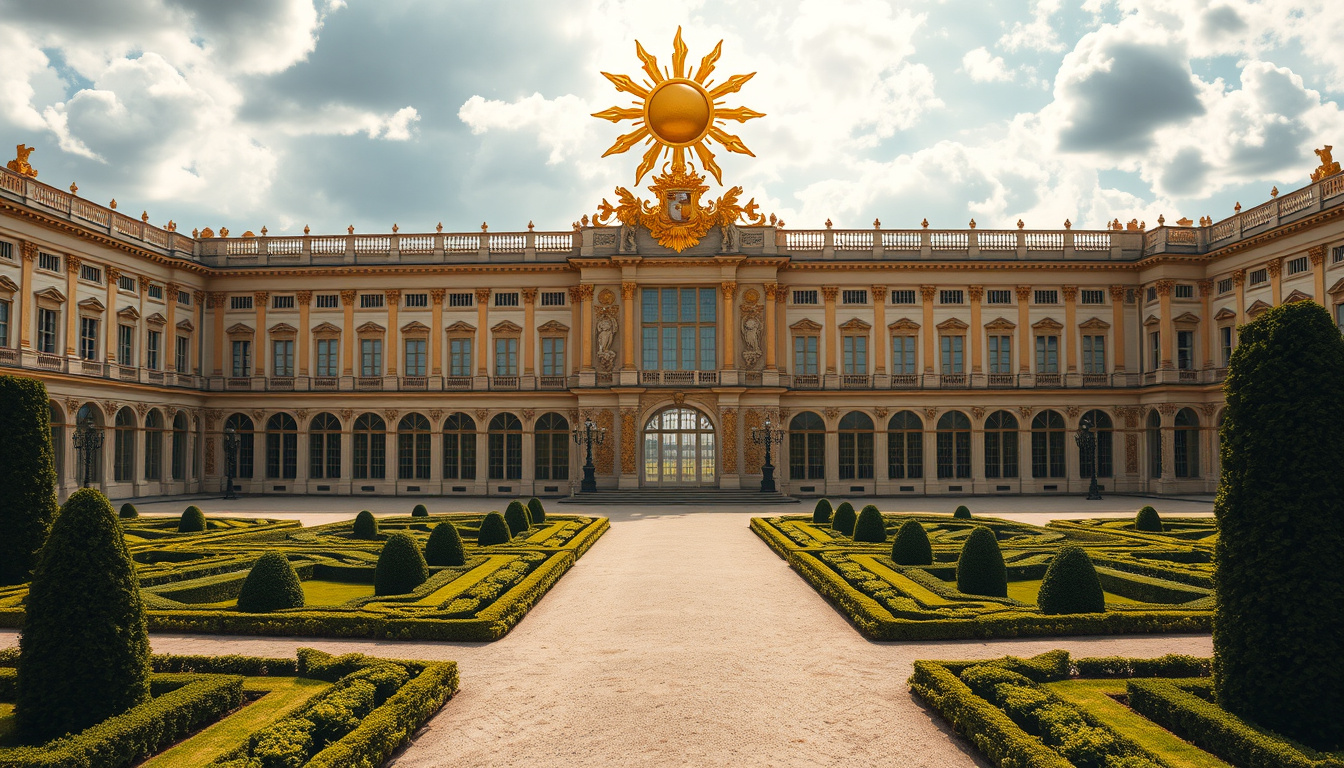
Louis XIV chose the sun as his personal emblem. The image evoked Apollo, the god of light and order, and implied that France, like the planets, revolved around its king.
What does Le Roi Soleil mean?
Le Roi Soleil translates as “the Sun King.” The title was not invented by later historians; it grew directly from the king’s own iconography and official ceremonies.
How did Louis XIV use the sun as a symbol?
The sun appeared in paintings, tapestries, medals, and the decoration of Versailles. It projected a centralized, all-encompassing royal authority, present in every corner of court life.
Turning rulers into symbols has a long visual history, and its darker consequences appear in works such as those explored in Francisco Goya Saturn Devouring – Meaning and Pop Culture.
When did the nickname become popular?
Solar imagery accompanied Louis throughout his reign. In court ballets, official portraits, and public architecture, the sun was the recurring signature of his power.
The sun was not decorative. It condensed a theory of absolute monarchy into a single image: all authority radiated from the king, and the entire kingdom depended on his light.
What Is Louis XIV’s Connection to the Palace of Versailles?
The history of Versailles as a royal residence is inseparable from Louis XIV. In 1682 he moved the court there, and the palace became the defining symbol of his rule and influence.
Did Louis XIV build the Palace of Versailles?
The expansion of Versailles was one of the defining projects of the reign. The palace became the center of royal power, the setting for court ritual, and a model for European royal courts.
Why did Louis XIV move his court to Versailles?
The move took the court out of Paris. Away from the capital, the nobility depended on the king’s favor, and rank was measured by proximity to him. Versailles became a political instrument as much as a residence.
When did the court arrive at Versailles?
The court officially moved in 1682. From that point, Versailles was the visible heart of the French monarchy.
Did King Louis XIV Really Dance in Royal Ballets?
Yes. Louis XIV performed in court ballets during his youth and early reign. Dancing was part of his public role, and he appeared on stage in elaborate roles that reinforced the image of a vigorous, divinely favored monarch.
Why did Louis XIV dance in ballets?
Ballet at the French court was both entertainment and political display. A king who danced well displayed grace, health, and command. The ballets were carefully staged to cast the monarch as the center of the social order.
What role did Louis XIV play in the development of ballet?
His patronage helped turn ballet into a professional art. Composers such as Lully and playwrights such as Molière worked under royal protection, and the arts flourished as an extension of court policy.
What Surgery Did Louis XIV Undergo?
In November 1686, Louis XIV underwent surgery for an anal fistula. The operation was performed by the royal surgeon Charles-François Félix and became one of the most discussed medical events of the reign.
Why did Louis XIV need surgery?
The operation treated an anal fistula, a condition that had become serious enough to require surgical intervention. The procedure took place at a time when surgery carried considerable risk.
Who performed the surgery on Louis XIV?
Charles-François Félix, the king’s surgeon, carried out the operation. He is the name most closely associated with this episode of royal medicine.
How successful was Louis XIV’s surgery?
Louis survived the operation and lived for nearly three more decades, until 1715. The operation and the surgeon are documented, but the details of the procedure itself are less clear.
Surgery in the 1680s took place without modern anesthesia or antiseptics. The survival of the king after such an operation was not guaranteed, which makes the 1686 intervention notable.
What Are the Whiskey, Liquor, and Strain Named ‘King Louis XIV’?
The royal name has a second, commercial life. Searches for “King Louis XIV whiskey,” “liquor,” or “strain” return products that use the monarch’s name as a brand rather than as a historical reference.
What is King Louis XIV whiskey?
Some premium spirits borrow the royal title for marketing. The historical king died in 1715, long before the modern spirits industry adopted aristocratic names, and these bottles have no documented connection to the French court.
What is the Louis XIV strain?
The cannabis strain also carries the name. Like the spirits, it is a commercial product that trades on royal imagery rather than historical provenance.
Louis XIV vs Louis XVI: What is the difference?
Louis XVI ruled more than a century after Louis XIV. He was the last king before the French Revolution and was executed in 1793, while Louis XIV died in 1715 as the central figure of the Ancien Régime. The two are often confused because of their similar titles.
A “Louis XIV” whiskey bottle or cannabis strain is a modern commercial product named after the monarch. It is not a royal artifact, and it carries no endorsement from the French crown or the Château de Versailles.
What Were the Key Dates in Louis XIV’s Life?
The main events of Louis XIV’s biography are well established across historical timelines.
- – Birth of Louis Dieudonné at the Château de Saint-Germain-en-Laye.
- – Becomes King of France at age four; his mother, Anne of Austria, serves as regent.
- – The Fronde, an uprising of nobles and Parlement, creates Louis’s lifelong distrust of Paris.
- – Coronation at Reims Cathedral.
- – Marriage to Maria Theresa of Spain, sealing the Peace of the Pyrenees.
- – Death of Cardinal Mazarin; Louis begins personal rule.
- – The royal court officially moves to Versailles.
- – Revocation of the Edict of Nantes curtails Protestant religious freedom.
- – Anal fistula surgery performed by royal surgeon Charles-François Félix.
- – Death of Louis XIV at Versailles; he is succeeded by his great-grandson, Louis XV.
What Is Confirmed and What Remains Uncertain About Louis XIV?
The broad outline of Louis XIV’s life is well documented. Some famous details, however, rest on weaker evidence than popular accounts suggest.
| Established information | Information that remains unclear |
|---|---|
| Dates of birth, reign, and death: 5 September 1638, 14 May 1643, 1 September 1715. | The exact quote “L’État, c’est moi” is widely attributed to Louis XIV but not documented before his death. Modern historians treat it as likely apocryphal. |
| The building of Versailles and the court move of 1682. | The claim of the longest reign in the history of all monarchies requires nuance; Sobhuza II of Eswatini is often listed at 82 years, though records and definitions vary. |
| The performance and patronage of ballet, including royal ballets. | The cause of death is attributed to gangrene from a leg ulcer, but whether diabetes or infection triggered it remains a medical-historical hypothesis. |
| The anal fistula surgery of 1686 by Charles-François Félix. | Myths around the Man in the Iron Mask are fiction and have never been proven. |
Why Does Louis XIV’s Reign Still Matter?
Louis XIV turned absolute monarchy into a working system of spectacle and control. The Fronde, which he experienced as a child, shaped his conviction that power had to be concentrated in one place and one person. Versailles became the physical proof of that conviction.
His religious policy had lasting costs. The Revocation of the Edict of Nantes in 1685 removed legal protection from French Protestants and pushed many skilled workers into exile. His wars, including the Nine Years’ War and the War of the Spanish Succession, extended French influence across Europe but left the kingdom militarily extended.
The fascination with Louis XIV persists in biography, tourism, and popular culture. His life is studied as much for its myths as for its facts. The same biographical curiosity surrounds figures such as George Washington – Biography, Height, Wife & Slavery Facts.
Where Can You Find Reliable Information About Louis XIV?
The most authoritative sources include the Château de Versailles, the memoirs of Saint-Simon, and the French National Archives. Among modern references, Britannica publishes reviewed biographical summaries of the king.
“L’État, c’est moi”
Attributed to Louis XIV
The quote is one of the most famous in French history, but historians approach it with caution. No contemporary record documents Louis saying it, and most scholars consider it a later invention. The memory of the king owes as much to legend as to documented fact.
What Is King Louis XIV’s Lasting Legacy?
Louis XIV left France a more centralized state, a court culture that became a European model, and an artistic heritage that still shapes the country’s image. He also left a warning about the costs of absolutism: religious intolerance, repeated war, and growing financial pressure. The Sun King embodied both the brilliance and the limits of absolute monarchy.
How did King Louis XIV die?
He died of gangrene in his leg on 1 September 1715, at the Palace of Versailles.
Was Louis XIV the longest-reigning king ever?
He has the longest undisputed reign in European history at 72 years. World records place other monarchs higher, depending on definitions.
What happened to Louis XIV’s son?
His legitimate son, Louis the Grand Dauphin, died in 1711, leaving the succession to his great-grandson.
Is Louis XIV the same as Louis XVI?
No. Louis XVI was the last king before the French Revolution and was executed in 1793. Louis XIV reigned a century earlier.
Did the Bourbon dynasty end with Louis XIV?
No. He was succeeded by his great-grandson, Louis XV, and the Bourbon dynasty continued.
Was the Man in the Iron Mask Louis XIV’s twin brother?
No evidence supports this legend. It is a popular myth with no documented basis.
How tall was King Louis XIV?
Historical estimates range around 1.75 m (5 ft 9 in), but interpretations of the records vary.

Rebecca Haines is Managing Editor at DailyCity.co.uk, running the daily news list and covering UK and world stories with a city lens.