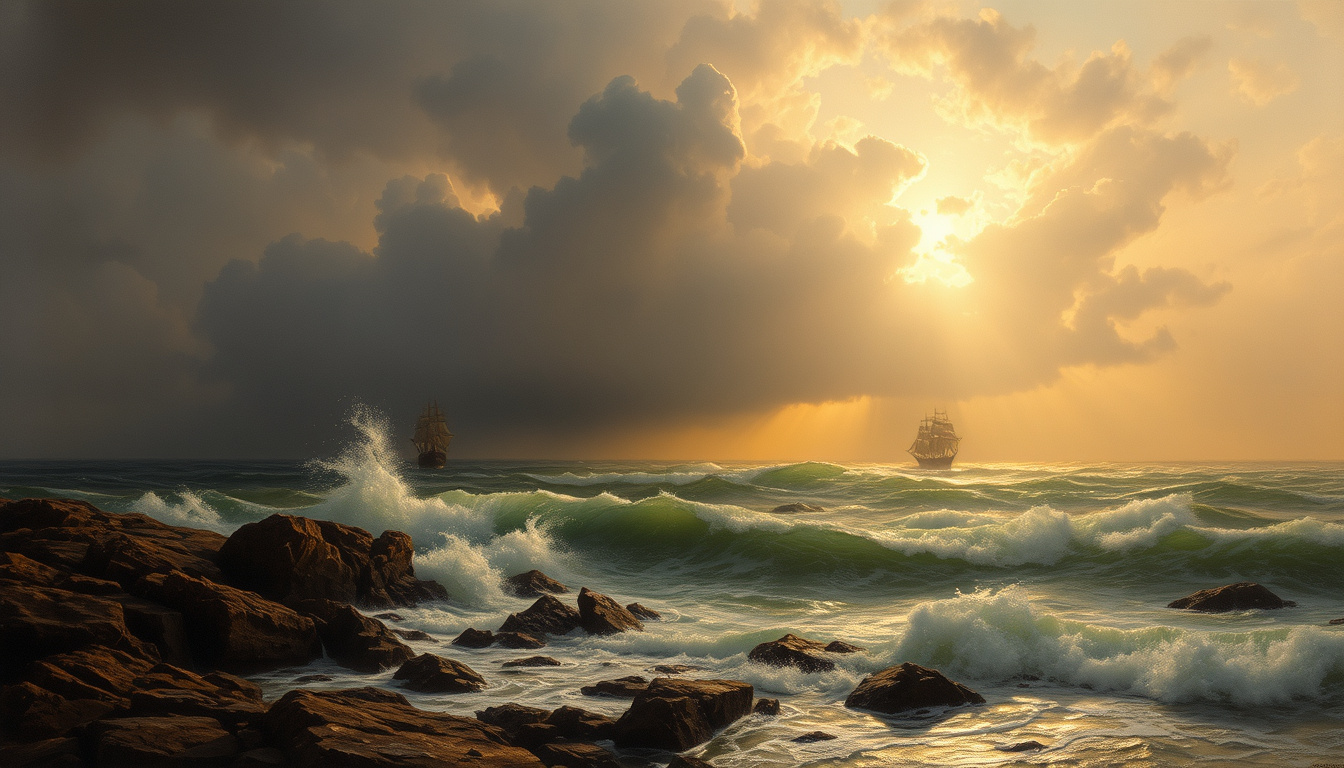
Joseph Mallord William Turner, the English Romantic painter known as the “painter of light,” transformed landscape art forever. From his luminous seascapes to the burning of Parliament, his work still captivates audiences. But who was the man behind the masterpieces? Did he marry, and does a photograph of him exist? This guide explores his life, his most famous paintings, where to see his art today, and the film that brought his story to a new generation.
Turner was born near Covent Garden, London, in 1775, the son of a barber and wig-maker. He entered the Royal Academy Schools at just 14, exhibiting his first work there in 1790. His career was meteoric—elected an Associate of the Royal Academy in 1799 and a full Royal Academician by 1802, an unusually early achievement. He would go on to become one of Britain’s most influential artists, leaving behind a vast body of work that includes nearly 300 oil paintings and around 30,000 sketches and watercolours.
Turner’s legacy is immense. Tate describes him as a tireless traveller, poet, teacher, and master draughtsman whose work captures the energy of his age. His bold use of light and atmospheric effects pushed painting toward abstraction and deeply influenced the Impressionists who followed. He remains a central figure in British art, his works held in the nation’s most important collections.
What Are J. M. W. Turner’s Most Famous Paintings?
Joseph Mallord William Turner
23 April 1775, London, England
19 December 1851, London, England
Romanticism
Painting, Watercolour, Printmaking
The Painter of Light
Tate Britain, National Gallery, Royal Academy of Arts
The Fighting Temeraire, Rain Steam and Speed, The Burning of the Houses of Lords and Commons
- J. M. W. Turner transformed landscape painting into a vehicle for sublime emotion.
- His technique evolved from precise topographical works to ethereal, light-infused masterpieces.
- Known as the “painter of light”, his influence is seen in Impressionism.
- He never married, but had a long-term housekeeper.
- He left over 30,000 works to the British nation as the Turner Bequest.
- Painted The Fighting Temeraire, his most famous work.
- An early photograph (daguerreotype) exists of him, one of the first of a major British artist.
| Painting | Year | Location | Significance |
|---|---|---|---|
| The Fighting Temeraire | 1839 | National Gallery, London | Voted Britain’s greatest painting in a 2005 BBC poll. |
| Rain, Steam and Speed – The Great Western Railway | 1844 | National Gallery, London | Captures the energy of industrial modernity. |
| Dutch Boats in a Gale | 1801 | National Gallery, London | Early marine masterpiece demonstrating his command of weather and sea. |
| Sun Rising through Vapour | 1807 | National Gallery, London | A luminous early work praised by critic John Ruskin. |
| The Burning of the Houses of Lords and Commons | 1835 | Tate Britain / Philadelphia Museum of Art | Dramatic depiction of a real historical event, painted from a boat on the Thames. |
| Snow Storm – Steam-Boat off a Harbour’s Mouth | 1842 | Tate Britain | Controversial at the time for its near-abstract swirl of weather. |
| The Slave Ship | 1840 | Museum of Fine Arts, Boston | A powerful abolitionist statement, blending politics with sublime nature. |
| Ulysses Deriding Polyphemus | 1829 | National Gallery, London | A mythological scene bathed in golden, Homeric light. |
Turner is especially associated with luminous landscapes, storm scenes, and marine subjects. His art moved away from conventional history painting and helped raise the status of landscape painting. He is often described as a master of atmospheric effects, with a style that influenced later modern art. His connection to places such as Margate is part of his wider fascination with sea, weather, and coastal light, themes that are central to his mature work.
Where Is JMW Turner On View and Are His Paintings for Sale?
Major Public Collections
Most of Turner’s paintings are now at Tate Britain, where the Turner Bequest forms the core of the collection. The National Gallery also retains important Turner oils, including several key works from his legacy. His 1851 bequest remains one of the most important gifts of art ever made to the British nation. The Turner Contemporary gallery in Margate also celebrates his connection to the coastal town.
For the largest concentration of Turner’s work, visit Tate Britain on Millbank. For his most famous single painting, The Fighting Temeraire, head to the National Gallery in Trafalgar Square. Both institutions hold major, permanent displays of his work.
Paintings for Sale
Turner’s works appear only rarely on the market because many major paintings are held in public collections, especially Tate Britain and the National Gallery. No verified current sales listing exists for Turner’s works. In practice, they are extremely difficult to acquire, and when they do appear at auction, they command very high prices.
Did J. M. W. Turner Have a Wife, and Is There a Photograph of Him?
His Marital Status
Historical records show that Turner never legally married or had legitimate children. He did have a long-term housekeeper and companion named Sarah Danby, though the specific nature of their relationship remains unclear. After his mother’s death, his father lived with him and acted as his assistant for many years.
The Photograph Question
Turner was born in 1775 and died in 1851, meaning he lived during the very earliest days of photography. An early daguerreotype, likely taken around 1849, is widely accepted to depict Turner, making him one of the first major British artists to be photographed. However, the exact identity of the sitter in this image is not absolutely confirmed by primary sources; available museum records focus instead on portraits, drawings, and documentary records.
Upon his death in 1851, Turner left nearly 300 oil paintings and around 30,000 sketches and watercolours to the British nation. This vast collection, known as the Turner Bequest, is now housed primarily at Tate Britain and is one of the most important gifts of art ever made to the country.
Is There a J. M. W. Turner Movie?
Yes, the film Mr. Turner, directed by Mike Leigh and released in 2014, popularized his life story for modern audiences. Starring Timothy Spall in an acclaimed performance, the film explores Turner’s later years, his artistic process, his complex relationships, and his gruff, independent personality. It reinforced his reputation as a complex, independent artist. It is best understood as a cultural portrayal of Turner rather than a source for primary biographical facts.
J. M. W. Turner Timeline
- 1775: Born in London.
- 1789: Enters the Royal Academy of Art schools.
- 1802: Elected full Royal Academician.
- 1819: First visit to Italy.
- 1839: Paints The Fighting Temeraire.
- 1849: Likely daguerreotype photograph taken.
- 1851: Dies in London.
- 2014: Mr. Turner film starring Timothy Spall released.
What Is Known and What Remains Uncertain About Turner’s Personal Life?
| Established Information | Information That Remains Unclear |
|---|---|
| He never legally married or had legitimate children. | The exact identity of the sitter in the 1849 Daguerreotype (though widely accepted to be Turner). |
| His works are overwhelmingly held in public collections (Tate, National Gallery). | The specific nature of his relationship with Sarah Danby (housekeeper/mistress). |
| He is considered a central figure of British Romantic painting. | — |
Turner’s Place in Art History
Turner stands as a bridge between the strict classical landscapes of the 18th century and the impressionistic visions of the 19th. His later works, with their swirling light and color, were initially derided as “soapsuds and whitewash” but are now hailed as proto-Impressionist masterpieces. His legacy is institutionalized in the Turner Prize, named in his honour, which is awarded annually to a British visual artist under 50. His influence can be seen in movements from Impressionism to Abstract Expressionism. For another master of the Romantic era, explore the work of his Spanish contemporary: Francisco Goya Saturn Devouring – Meaning and Pop Culture.
Where Do the Key Facts About Turner Come From?
“The sun is God.”
J. M. W. Turner, attributed deathbed words.
“He is the painter of light.”
John Ruskin, Modern Painters, 1843.
What Is the Lasting Legacy of J. M. W. Turner?
Turner’s popularity shows no signs of waning. Tate Britain holds annual Turner exhibitions. The market for his watercolours remains strong. Continued digitization of the Turner Bequest brings his works to a global audience. His legacy is still strongly tied to British institutions, especially Tate Britain and the National Gallery, where his art continues to be shown and studied. His influence on art is as profound as that of other great historical figures; learn more about the age of patronage in our piece on King Louis XIV – The Sun King Biography, Versailles and Legacy.
Frequently Asked Questions
What is J. M. W. Turner best known for?
He is best known as the “painter of light” and for his luminous landscapes, stormy seascapes, and dramatic atmospheric effects. His most famous painting is The Fighting Temeraire.
Did J. M. W. Turner ever marry?
No, he never legally married or had legitimate children. He had a long-term relationship with his housekeeper, Sarah Danby.
Where can I see Turner’s paintings in London?
The largest collection is at Tate Britain. The National Gallery also holds several key works, including The Fighting Temeraire and Rain, Steam and Speed.
Is there a photograph of J. M. W. Turner?
A daguerreotype from around 1849 is widely believed to be of Turner, making him one of the first major British artists photographed, but the identification is not absolutely certain.
What is the Turner Bequest?
It is the vast collection of nearly 300 oil paintings and around 30,000 sketches and watercolours that Turner left to the British nation upon his death in 1851.
Which film tells the story of J. M. W. Turner?
Mike Leigh’s 2014 film Mr. Turner, starring Timothy Spall, portrays his later life and artistic career.
What was Turner’s connection to Margate?
Margate’s coastal light and weather fascinated Turner, and these themes are central to his mature work. The Turner Contemporary gallery in Margate celebrates this connection.
Can I buy a J. M. W. Turner painting?
Turner’s major works are almost all held in public collections and rarely come to market. When they do, they command extremely high prices at auction.
What art movement is Turner associated with?
He is a central figure of the English Romantic movement. His later work is also seen as a precursor to Impressionism.
How old was Turner when he entered the Royal Academy?
He entered the Royal Academy Schools at the age of 14 in 1789.

Sophie Kendall is Culture & Events Editor at DailyCity.co.uk, covering restaurants, nightlife, theatre, exhibitions, festivals and city life.