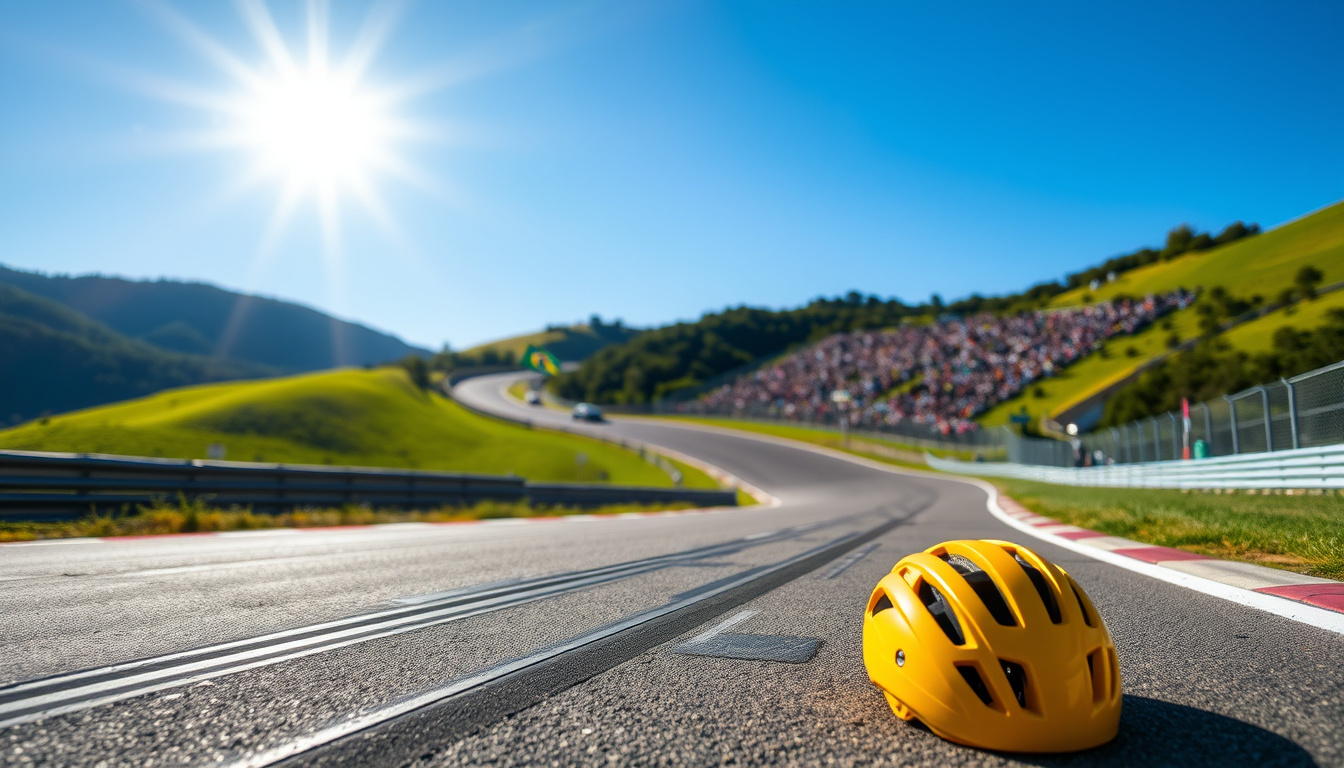
Ayrton Senna da Silva, the Brazilian Formula 1 driver, remains one of the most iconic figures in motorsport history. His blend of raw speed, technical precision, and magnetic personality made him a three-time world champion and a national hero in Brazil. Decades after his tragic death, Senna’s name still commands global recognition and respect.
Senna’s career was defined by his fierce rivalry with Alain Prost and his incredible performances in wet weather, which many consider unmatched. He secured all three of his World Drivers’ Championships with McLaren, a team that remains intertwined with his legacy. His move to Williams in 1994 was seen as a new chapter in an already legendary career.
That chapter was cut short on 1 May 1994 at the San Marino Grand Prix in Imola, Italy. Senna’s crash at the Tamburello corner sent shockwaves around the world and led to a fundamental reassessment of safety in Formula 1. This article provides a comprehensive look at his life, career, the details of the crash, and the legacy he left behind.
Who Was Ayrton Senna?
Ayrton Senna da Silva was a Brazilian racing driver whose impact on Formula 1 and Brazilian culture is immeasurable. He began his F1 career with Toleman in 1984 and quickly showcased his exceptional talent, particularly in the wet conditions of the Monaco Grand Prix that year. He moved to Lotus in 1985, where he took his first Grand Prix victories in Portugal and Belgium.
Senna’s most successful period came with McLaren, which he joined in 1988. Over six seasons with the team, he won three World Championships (1988, 1990, 1991) and established himself as the benchmark for qualifying speed and racecraft. His rivalry with teammate Alain Prost became the defining narrative of late 1980s and early 1990s Formula 1.
Key Insights into Senna’s Enduring Fame
- Senna is searched not only as a historical F1 statistic but as a cultural icon, which makes legacy, helmet, and movie content necessary.
- Death-related queries are high-friction; users need a quick, factual cause-of-death answer before a fuller crash narrative.
- The helmet and number queries indicate a visual/identity search behavior that can be satisfied with clear, image-driven sections.
- The ‘Ferrari’ query is a recurring myth/verification search; the page should address it honestly without speculation.
- Relationship searches reveal an interest in the human story behind Senna’s career, beyond race results.
Ayrton Senna: Facts at a Glance
| Attribute | Detail |
|---|---|
| Full Name | Ayrton Senna da Silva |
| Born | 21 March 1960, São Paulo, Brazil |
| Died | 1 May 1994, Imola, Italy |
| Nationality | Brazilian |
| F1 Teams | Toleman, Lotus, McLaren, Williams |
| World Championships | 3 |
| Race Wins | 41 |
| Pole Positions | 65 |
| Podiums | 80 |
| Fastest Laps | 19 |
How Did Ayrton Senna Die?
Ayrton Senna died on 1 May 1994, following a high-speed crash during the San Marino Grand Prix at the Autodromo Enzo e Dino Ferrari in Imola, Italy. The crash occurred on the seventh lap of the race while Senna was leading in his Williams FW16. The incident remains one of the most analyzed and discussed moments in motorsport history.
What Happened at the Tamburello Corner?
As Senna approached the fast left-hand Tamburello corner, his car left the track at around 145 mph (233 km/h) and struck the concrete retaining wall. The impact was violent, and a suspension component or wheel assembly penetrated the cockpit, striking Senna’s helmet. He was extracted from the car and airlifted to the Maggiore Hospital in Bologna, where he was pronounced dead later that day.
What Was the Official Cause of Death?
The official cause of death was determined to be severe head injuries caused by the penetration of his helmet by debris. The impact caused catastrophic skull and brain trauma. The immediate cause of the crash, according to later legal and technical reviews, was widely reported as a mechanical failure related to the steering column.
Senna’s death was the second fatal crash of the 1994 San Marino Grand Prix weekend. The day prior, Austrian driver Roland Ratzenberger had died during qualifying after a crash at the Villeneuve corner. The events of this weekend served as a major catalyst for sweeping safety reforms in Formula 1, led by the FIA. Read more in our Formula 1 Safety History.
Was it a Mechanical Failure or Driver Error?
The consensus from judicial and technical inquiries is that the crash was caused by a mechanical failure, specifically a modified and broken steering column. There has been enduring debate over the precise chain of failure, but the crash is consistently linked to a mechanical problem rather than driver error.
What Car and Number Was Ayrton Senna Known For?
Senna’s career is closely associated with the cars he drove for McLaren, though he also raced for Toleman, Lotus, and Williams. His iconic status is also tied to the number 12, which he used during his most dominant years. The question of whether he ever drove for Ferrari is a persistent myth in F1 circles.
What Car Did Ayrton Senna Drive?
Senna drove for four F1 teams during his career. He made his debut with Toleman in 1984, drove for Lotus from 1985 to 1987, and joined McLaren in 1988, where he achieved his greatest success. In 1994, he moved to Williams, where he tragically lost his life driving the FW16. The car from the crash, FW16 chassis No. 02, was later impounded and eventually returned to Williams years afterward.
What Number Did Ayrton Senna Use?
Ayrton Senna is most famously associated with the number 12, which he used during his championship-winning years with McLaren. Prior to this, he used number 2 at Lotus and number 31 at Toleman. The number 12 became a symbol of his identity, and its use by subsequent drivers is often seen as a tribute to his legacy.
Did Ayrton Senna Ever Drive for Ferrari?
No. Although there were persistent rumors and speculation about Senna joining Ferrari, particularly in the early 1990s, he never raced for the Italian team. The speculation was fueled by his close relationship with the Italian fans and the fact that he drove a Honda-powered McLaren. However, no binding contract was ever established, as confirmed by public records.
Why Is Ayrton Senna’s Helmet So Iconic?
Ayrton Senna’s helmet is one of the most recognizable designs in the history of motorsport. The striking yellow, green, and blue color scheme made it instantly visible on track, even from a distance. Its design was not just for aesthetics; it was a deeply personal emblem of his Brazilian identity.
The helmet’s design was heavily influenced by the colors of the Brazilian flag. The yellow base, green stripes, and blue top band were a deliberate representation of his national pride. This visual identity became so powerful that it is now synonymous with Senna himself, often used in tributes and merchandise.
What Did Ayrton Senna’s Helmet Design Symbolize?
The design symbolized Senna’s deep connection to his country. He was a national hero in Brazil, and his helmet was a canvas for his patriotism. The distinctive yellow base was chosen to stand out in the rain, a condition in which Senna excelled, famously winning the 1984 Monaco Grand Prix in a torrential downpour in an underpowered Toleman.
Why Are Yellow and Green Associated with Senna?
The yellow and green are the primary colors of the Brazilian flag. By wearing these colors, Senna carried his nation’s hopes with him every time he raced. This connection between driver and country was incredibly strong, and his helmet became a symbol of Brazilian excellence and determination on the world stage.
What Is the Timeline of Ayrton Senna’s Life and Career?
Senna’s journey from a karting prodigy in São Paulo to a three-time Formula 1 World Champion was marked by incredible highs and a tragic end. The following timeline outlines the key milestones in his life and career.
- 21 Mar 1960: Born in São Paulo, Brazil.
- 1984: Formula 1 debut with Toleman.
- 1988: First F1 World Championship with McLaren.
- 1990: Second F1 World Championship.
- 1991: Third F1 World Championship.
- 1994: Joined Williams for the season.
- 1 May 1994: Fatal crash at the San Marino Grand Prix, Imola.
What Is Certain and Uncertain About the Crash?
While the broad facts of Ayrton Senna’s death are well-established, some details of the crash remain a subject of debate among experts and fans. The table below separates the established information from the aspects that remain unclear.
| Established Information | Information That Remains Unclear |
|---|---|
| Ayrton Senna crashed on lap 7 of the 1994 San Marino Grand Prix at Tamburello corner. | The precise mechanical sequence that caused the Williams FW16 to leave the track is still debated. |
| He was taken to hospital and died on 1 May 1994. | Whether Ferrari negotiations ever reached a binding contract is not established by public records. |
| Senna’s death was caused by severe head injuries. | The exact relative contribution of track conditions, car failure, and race-weekend factors remains a matter of interpretation. |
| He was 34 years old at the time of his death. | |
| He won 3 Formula 1 World Championships and 41 Grands Prix. |
Who Were the Key Figures Around Ayrton Senna?
Senna’s career was shaped by several key individuals, including team bosses and a close friend who was also his trackside doctor. Frank Williams was the team principal of Williams Racing, which Senna joined in 1994. Ron Dennis was the head of McLaren, where Senna won his three world titles. Their relationship was complex, built on a shared pursuit of excellence but also marked by tension.
While the significance of figures like Professor Sid Watkins, who was Senna’s friend and the F1 trackside doctor, is well known, specific detailed quotes and accounts of their relationships often rely on primary sources such as autobiographies and dedicated documentaries. The information available in public legal and technical reviews focuses more on the crash sequence than personal interactions.
Professor Sid Watkins was the Formula 1 doctor who was a close friend of Senna. He was one of the first people to reach Senna after the crash. Martin Donnelly, a fellow driver, had a severe crash in 1990, and Senna was one of the first to reach him, showcasing the camaraderie among drivers beneath the intense rivalry.
What Do the Official Sources Say About His Legacy?
Official sources consistently describe Senna as a fearless, victorious, and charismatic driver whose impact on Formula 1 transcends the sport. The Formula 1 Hall of Fame profile highlights his three world championships and his status as a national hero. McLaren’s heritage page celebrates his time with the team, emphasizing his 35 wins for McLaren.
“Senna is remembered as a benchmark for driver skill and as a cultural icon far beyond motorsport.”
— Official Senna.com biography
“Lewis Hamilton has repeatedly cited Senna as an idol and one of the sport’s most iconic drivers.”
— Sky Sports F1
Why Does Ayrton Senna’s Legacy Endure?
Ayrton Senna’s legacy endures because he represented the pinnacle of human skill, courage, and passion in a sport that operates on the edge of possibility. His death acted as a catalyst for the modern safety standards that define Formula 1 today, ensuring that his impact is felt by every driver who races in the post-1994 era. For more on the drivers who shaped the sport, visit our Formula 1 Legends Hub.
Frequently Asked Questions About Ayrton Senna
How does Lewis Hamilton compare to Ayrton Senna?
Lewis Hamilton has surpassed Senna’s 41 wins and three world titles, but he has often cited Senna as an idol. Comparisons typically focus on raw speed, qualifying brilliance, and cultural impact.
How old was Ayrton Senna when he died?
Ayrton Senna was 34 years old when he died on 1 May 1994.
What is the Martin Donnelly–Senna connection?
Martin Donnelly suffered a severe crash during qualifying for the 1990 Portuguese Grand Prix. Senna was one of the first drivers to reach him, and the incident remained part of Formula 1’s safety history.
What is the ‘Senna’ documentary?
The 2010 documentary “Senna,” directed by Asif Kapadia, is a critically acclaimed film that chronicles Senna’s life and career using archival footage. It is widely considered the definitive film on his life.
What was Ayrton Senna’s car number?
Ayrton Senna is most famously associated with the number 12, which he used during his championship-winning years with McLaren.
Where is Ayrton Senna buried?
Ayrton Senna is buried in the Morumbi Cemetery in his hometown of São Paulo, Brazil. His grave is a site of pilgrimage for fans from around the world.

Olivia Hartley is Business & Economy Correspondent at DailyCity.co.uk, reporting on the city economy, property, retail, hospitality and employment.