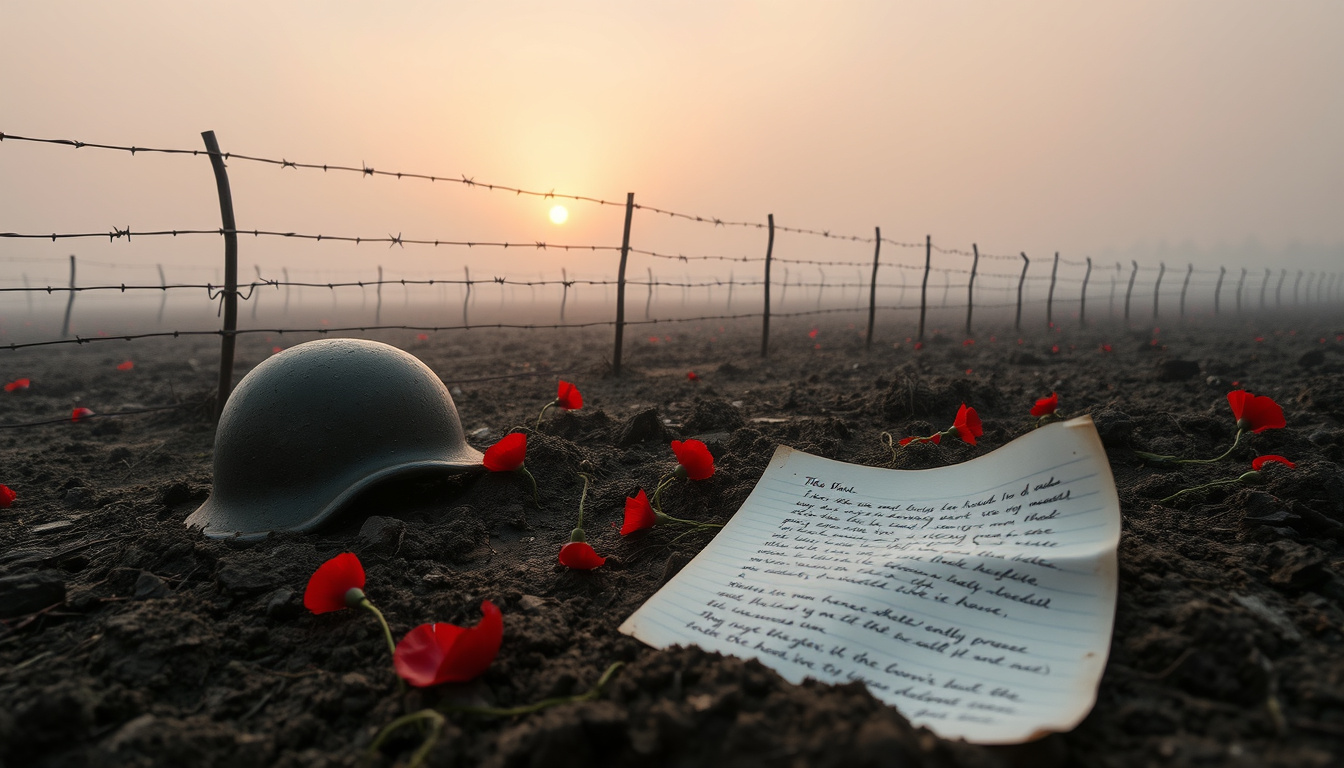
Wilfred Owen died at 25, one week before the Armistice, but in his final year he wrote some of the most powerful anti-war poetry in the English language. His graphic depictions of gas attacks, trench warfare, and the psychological toll of combat shattered the romanticised view of war held by many at the time. Today, Owen is regarded as the defining poetic voice of the First World War.
Born in Shropshire in 1893, Owen was still a teenager when he began writing verse. He taught English in France before enlisting in the British Army in 1915. After being wounded and diagnosed with shell shock, he was sent to Craiglockhart War Hospital, where he met Siegfried Sassoon – a meeting that would transform his writing and his legacy.
Only five of Owen’s poems were published while he was alive. Sassoon and others championed his work after his death, ensuring that the raw, unflinching reality of the trenches would not be forgotten. Owen’s phrase “the poetry is in the pity” remains the guiding principle of his entire body of work.
Who Was Wilfred Owen?
Wilfred Edward Salter Owen (1893–1918), English poet and soldier
Over 80 poems, most notably ‘Dulce et Decorum Est’, ‘Strange Meeting’, ‘Anthem for Doomed Youth’
One of the greatest voices of WWI; poetry focuses on the pity and reality of war
Mentored by Siegfried Sassoon; posthumously became a symbol of anti-war literature
- Wilfred Owen wrote nearly all his major poems in a 13-month period after being diagnosed with shell shock.
- His poetry was largely unknown until after his death, published later by Siegfried Sassoon and Edith Sitwell.
- Owen is considered a master of pararhyme and vivid sensory imagery.
- He coined the phrase ‘the poetry is in the pity’ to describe his mission.
- Contrary to popular belief, Owen never married; he had close friendships with men, but no confirmed romantic partner.
| Fact | Detail |
|---|---|
| Born | 18 March 1893, Oswestry, Shropshire, England |
| Died | 4 November 1918 (aged 25), Sambre Canal, France (killed in action) |
| Notable Poems | Dulce et Decorum Est, Strange Meeting, Anthem for Doomed Youth, Futility, Mental Cases |
| Awards | Military Cross (posthumous), 1918 |
| Notable Relationships | Siegfried Sassoon (mentor), Robert Graves (acquaintance) |
| Wartime Hospital | Craiglockhart War Hospital, near Edinburgh |
| Active Writing Period | August 1917 – September 1918 |
| First Published Posthumously | 1920, edited by Siegfried Sassoon |
What Are Wilfred Owen’s Most Famous Poems?
Owen composed nearly all his poems in slightly over a year, from August 1917 to September 1918. Only five were published in his lifetime; the rest appeared posthumously, edited by Siegfried Sassoon. Each major poem carries a distinct attack on the glorification of war.
Dulce et Decorum Est
Owen’s most famous anti-war poem directly attacks the Latin phrase “it is sweet and fitting to die for one’s country.” The poem graphically describes a gas attack, using lines like “guttering, choking, drowning” to illustrate the physical terror of warfare. It contrasts the patriotic ideal with the reality of soldiers dying in pain and shame.
Owen uses a single extended metaphor of drowning even without water, creating a visceral sense of suffocation. The poem’s final stanza is a bitter, direct address to a reader who might still believe war is glorious.
Strange Meeting
A surreal poem depicting a meeting between a soldier and his dead enemy in a post-apocalyptic setting. They realise they are both victims of the same war machine. The enemy reveals that he could have been a great poet or leader if war had not destroyed him. Owen composed this in March 1918 at Ripon.
Anthem for Doomed Youth
Written at Craiglockhart, this poem laments the loss of young soldiers, comparing their deaths to the lack of traditional church rituals and mourning. It highlights the impersonal nature of mass death in war.
Exposure
This poem describes the brutal conditions of fighting in the snow and the psychological toll of waiting for battle. It details the gas attack and snow fighting Owen experienced in early 1917.
Why Is Wilfred Owen Considered a Leading War Poet?
The Poetry of Pity
Owen’s self-appointed task was to convey the horror and pity of war, rejecting the “dulce et decorum est” propaganda. His use of graphic imagery and irony exposes the gap between romanticised war and reality. He once wrote in a draft preface: “My subject is War, and the pity of War.”
Technical Innovation
Owen pioneered pararhyme (e.g., “escaped / scooped”) and combined traditional forms with modern diction. His poems often employ a single powerful metaphor extended throughout the piece. These experiments were particularly influential in the 1930s.
Benjamin Britten’s War Requiem (1962) set Owen’s poems to music, weaving them into the Latin requiem mass. This work brought Owen’s words to a new generation and cemented his status as a poet of universal significance.
Relationship with Siegfried Sassoon
At Craiglockhart War Hospital, Owen met fellow patient and poet Siegfried Sassoon, who became his mentor. Sassoon encouraged him to write about his traumatic experiences and introduced him to literary figures like Robert Graves and H.G. Wells. The encounter transformed Owen’s poetic voice.
What Is the Timeline of Wilfred Owen’s Life?
- 1893 – Born in Oswestry, Shropshire
- 1897 – Family moves to Birkenhead
- 1911 – Matriculates at University of London but fails scholarship
- 1913 – Teaches English in France
- 1915 – Enlists in the British Army
- 1916 – Commissioned into the Manchester Regiment; experiences trench warfare
- 1917 – Suffers shell shock; sent to Craiglockhart War Hospital where he meets Siegfried Sassoon
- 1918 – Returns to front line; wins Military Cross; killed on 4 November (one week before Armistice)
- 1920 – First collection of poems published posthumously
What Is Known and What Remains Unclear About Wilfred Owen’s Life?
| Established Information | Information That Remains Unclear |
|---|---|
| Wilfred Owen died on 4 November 1918, killed in action near the Sambre Canal. | The exact nature of Owen’s romantic/sexual orientation is debated; no confirmed partners are documented. |
| He never married and had no children. | Some details of his combat experiences before hospitalisation are incomplete. |
| He wrote his most famous poems between August 1917 and September 1918. | The precise dating of a few unpublished poems is uncertain. |
| His poetry was heavily influenced by his mentor Siegfried Sassoon. |
How Did Owen’s Experiences Shape His Poetry?
Owen’s work moved away from romanticised descriptions of war to raw, unflinching realism. His verse graphically illustrates the physical landscapes of the trenches and the human body within them. The conditions he endured – gas attacks, snow, the death of a close friend – became the raw material for his poems.
After the war, his collected poems, edited by Cecil Day-Lewis, were published in 1963 and are considered “the finest written by any English poet of the First War and probably the greatest poems about the war in our literature.” Owen, Sassoon, and 14 other WWI poets are memorialised in Westminster Abbey under a stone.
What Did Wilfred Owen and His Contemporaries Say About His Poetry?
“The poetry is in the pity.”
Wilfred Owen, from his draft preface to his poems
“My subject is War, and the pity of War.”
Wilfred Owen, draft preface
“He was the greatest poet of the war, and the representative poet of his time.”
Siegfried Sassoon (quoted on Poetry Foundation)
Why Does Wilfred Owen’s Legacy Endure?
Wilfred Owen is now widely recognised as the leading poet of the First World War, whose work continues to define the literary understanding of trench warfare. His anti-war message, technical innovations, and unwavering focus on human suffering have made his poems timeless. For readers seeking to understand the true cost of conflict, Owen’s words remain essential.
If you found this biography of the WWI poet insightful, you may also enjoy reading about Albert Einstein – Biography, IQ, Death and Lasting Legacy and Guy Fawkes – The Gunpowder Plot, Death and Why We Celebrate.
Frequently Asked Questions About Wilfred Owen
When did Wilfred Owen write most of his poems?
He wrote the bulk of his notable poems between August 1917 and September 1918, while recovering from shell shock and after returning to the front.
How many poems did Wilfred Owen write?
He wrote more than 80 poems; the exact number varies as some fragments and drafts exist. The definitive collection edited by Jon Stallworthy contains 89 poems.
Was Wilfred Owen married?
No, he never married and had no children. He was engaged in close friendships but no confirmed romantic partner is known.
What is the meaning of ‘Dulce et Decorum Est’?
The poem is a bitter denunciation of the Latin phrase ‘dulce et decorum est pro patria mori’ (it is sweet and fitting to die for one’s country). Owen uses a brutal gas attack scene to show that the reality of war is anything but sweet.
Where can I read Wilfred Owen’s poems online?
You can read his complete poems on the Poetry Foundation website, Poets.org, and the Wilfred Owen Association site.
Is Wilfred Owen buried in a war cemetery?
Yes, he is buried at Ors Communal Cemetery, Nord, France (grave reference: Plot H, Row 3, Grave 13).
How did Wilfred Owen die?
He was killed in action on 4 November 1918 while leading men across the Sambre-Oise canal at Ors, one week before the Armistice. He was 25 years old.
What awards did Wilfred Owen receive?
He was awarded the Military Cross for bravery at Amiens in 1918, presented posthumously.
Who was Siegfried Sassoon to Wilfred Owen?
Siegfried Sassoon was a fellow poet and soldier who became Owen’s mentor at Craiglockhart War Hospital. He encouraged Owen to write about his war experiences and later edited his poems for publication.
What is pararhyme and how did Owen use it?
Pararhyme is a poetic technique where the consonants match but vowels differ, e.g., “escaped / scooped”. Owen used it to create a haunting, dissonant effect that reflected the disharmony of war.

Daniel Mercer is Urban Affairs Editor at DailyCity.co.uk, covering councils, City Hall, planning, transport and infrastructure across London and major UK cities.