The Genesis of Gonzo
Hunter S. Thompson’s Fear and Loathing in Las Vegas: A Savage Journey to the Heart of the American Dream emerged from the dust of collapsed 1960s idealism. First serialized in Rolling Stone magazine in 1971, the narrative follows Raoul Duke and his attorney, Dr. Gonzo, as they careen through Las Vegas on a drug-fueled assignment to cover the Mint 400 motorcycle race. What began as a journalistic assignment transformed into a hallucinogenic indictment of American excess.
Essential Data
| Attribute | Details |
|---|---|
| Author | Hunter S. Thompson |
| Original Publication | 1971 (Rolling Stone) |
| Book Publisher | Random House |
| Film Director | Terry Gilliam |
| Film Release | 1998 |
| Genre | Gonzo Journalism/Fiction |
Critical Insights
The work operates simultaneously as reportage and surrealist fiction, blurring the line between observer and participant. Thompson’s innovative technique established the parameters of gonzo journalism, where the writer becomes the protagonist and subjective experience supersedes objective fact. The narrative’s paranoia and chemical consumption serve as metaphors for the national disillusionment following the Manson trials and the collapse of the hippie movement.
University curricula now regularly examine the text’s cultural impact alongside works by Kerouac and Burroughs, recognizing Thompson’s unflinching examination of the American psyche.
Comparative Analysis
| Element | Novel (1971) | Film (1998) |
|---|---|---|
| Narrative Voice | First-person stream of consciousness | Voice-over narration by Johnny Depp |
| Visual Style | Surrealist descriptive prose | Distorted cinematography, psychedelic color grading |
| Dr. Gonzo Portrayal | Based on Oscar Zeta Acosta | Benicio Del Toro’s physical transformation |
| Critical Reception | Instant cult classic | Mixed initial reviews, later reappraisal |
Narrative Details
The plot structure deliberately mimics a bad trip, with escalating absurdity and fragmented reality. Duke and Dr. Gonzo arrive in Las Vegas equipped with a trunk full of narcotics ostensibly to report on the Mint 400, the richest off-road race in history. When that assignment collapses into chaos, they flee to the District Attorney’s Convention on Narcotics and Dangerous Drugs, creating a savage irony that Thompson exploits to maximum effect.
The 1998 film adaptation directed by Terry Gilliam translates Thompson’s prose through grotesque visual metaphors. Johnny Depp spent months living with Thompson to capture the author’s mannerisms and speech patterns, while Benicio Del Toro gained forty pounds to embody the volatile attorney.
Timeline
- : Rolling Stone publishes Part I of the serialized narrative
- : Random House releases the complete novel with Ralph Steadman’s illustrations
- : Thompson approves Alex Cox’s initial screenplay treatment
- : Terry Gilliam replaces Cox as director; filming begins in Las Vegas
- : Theatrical release receives controversial reception at Cannes Film Festival
- : Criterion Collection releases restored edition with Thompson’s commentary
Clarity
Contrary to popular assumption, the novel is not merely a celebration of hedonism or a manual for substance abuse. Thompson’s savage journey documents the death of the 1960s utopian dream. The infamous “wave speech” midway through the narrative explicitly mourns the loss of hope and energy that characterized the counterculture’s peak.
Additionally, while cinema archives often categorize the film as pure comedy, Gilliam’s direction emphasizes the tragedy and horror inherent in the protagonists’ psychological dissolution.
Analysis
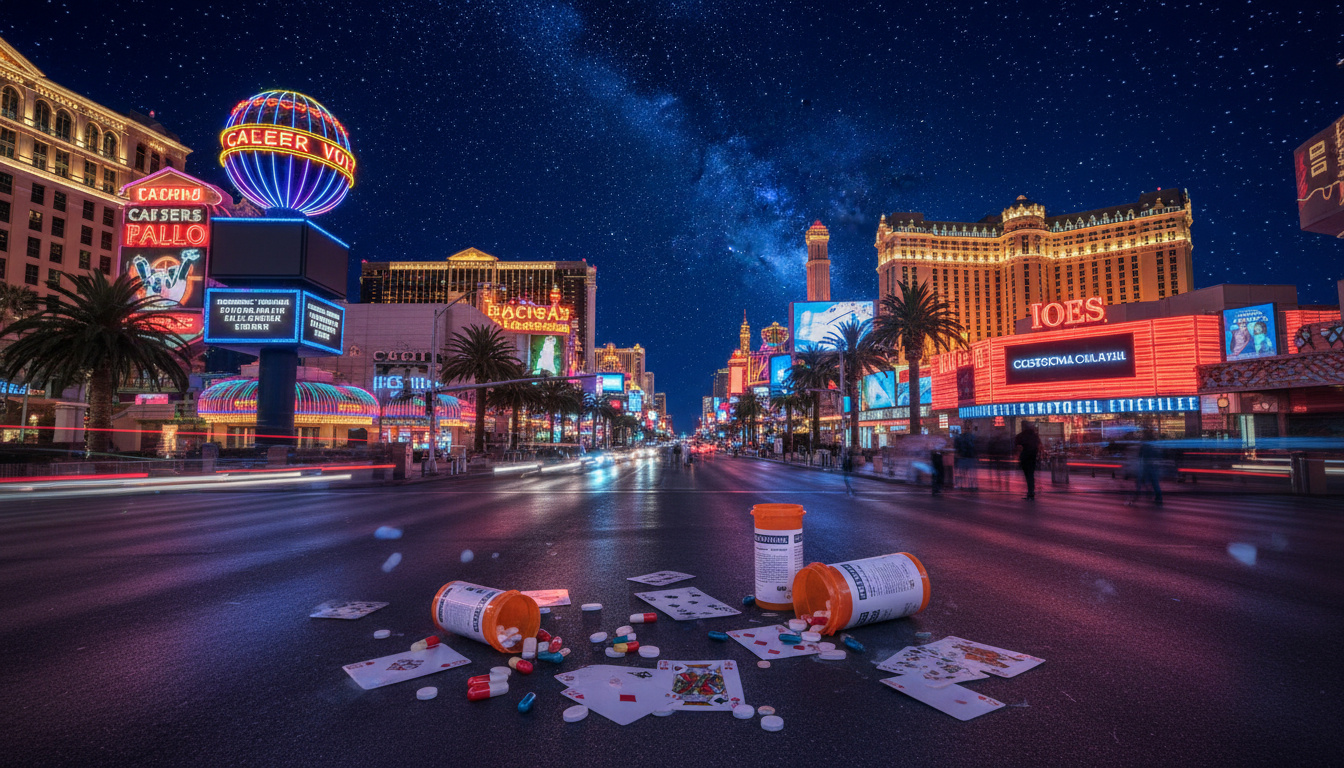
Las Vegas functions as the perfect metaphor for American capitalism: artificial, excessive, and predatory. The city’s neon wasteland provides the backdrop for Thompson’s investigation into the “American Dream in action.” The protagonists’ chemical consumption serves as both escape and magnification, allowing them to see the grotesque underbelly of the republic while rendering themselves incapable of coherent protest.
The published text maintains a precarious balance between hilarity and terror. Thompson’s prose accelerates and decelerates with pharmacological precision, creating rhythms that mirror the substances consuming his narrator.
Thompson’s relationship with Oscar Zeta Acosta, the real-life inspiration for Dr. Gonzo, adds another layer of complexity. Their actual journey to Las Vegas involved investigating the death of Mexican-American journalist Ruben Salazar, a detail Thompson fictionalized while maintaining the emotional truth of their disillusionment.
Quotes
We had two bags of grass, seventy-five pellets of mescaline, five sheets of high-powered blotter acid, a salt shaker half full of cocaine, and a whole galaxy of multi-colored uppers, downers, screamers, laughers… and also a quart of tequila, a quart of rum, a case of Budweiser, a pint of raw ether, and two dozen amyls.
— Opening paragraph, Fear and Loathing in Las Vegas
There was madness in any direction, at any hour. If not across the Bay, then up the Golden Gate or down 101 to Los Altos or La Honda… You could strike sparks anywhere. There was a fantastic universal sense that whatever we were doing was right, that we were winning.
— The Wave Speech
Summary
More than five decades after its initial publication, Fear and Loathing in Las Vegas remains essential reading for understanding the psychological aftermath of the 1960s. The work transcends its reputation as a drug narrative to become a profound meditation on disillusionment and the corruption of American idealism. Gilliam’s film adaptation, initially misunderstood by critics, has achieved canonical status among cult cinema enthusiasts for its uncompromising visual translation of Thompson’s nightmare vision.
FAQ
Is Fear and Loathing in Las Vegas based on real events?
Yes. Hunter S. Thompson based the narrative on two trips to Las Vegas with Chicano lawyer Oscar Zeta Acosta, who inspired the character of Dr. Gonzo. The Mint 400 race and the narcotics conference both occurred, though Thompson embellished and fictionalized specific incidents.
What does the title “Fear and Loathing” refer to?
Thompson coined the phrase to describe the dominant emotions he observed in American society during the early 1970s: fear of the future and loathing of the present conditions. It became his signature phrase for describing the cultural malaise following the 1960s.
Why did Terry Gilliam replace Alex Cox as director?
Thompson and star Johnny Depp disagreed with Cox’s comedic approach to the material. Gilliam, formerly of Monty Python, possessed the surreal visual sensibility necessary to capture the novel’s hallucinogenic qualities while maintaining its tragic undertones.
What is “gonzo journalism”?
Gonzo journalism eliminates the traditional barrier between objective reporter and subjective participant. The writer inserts themselves into the narrative as a central character, emphasizing personal experience and emotional truth over conventional factual accuracy.
Did Hunter S. Thompson like the film adaptation?
Thompson enthusiastically endorsed Gilliam’s version, particularly Depp’s performance. He participated in the Criterion Collection DVD commentary and maintained a friendship with Depp until his death in 2005.

Daniel Mercer is Urban Affairs Editor at DailyCity.co.uk, covering councils, City Hall, planning, transport and infrastructure across London and major UK cities.