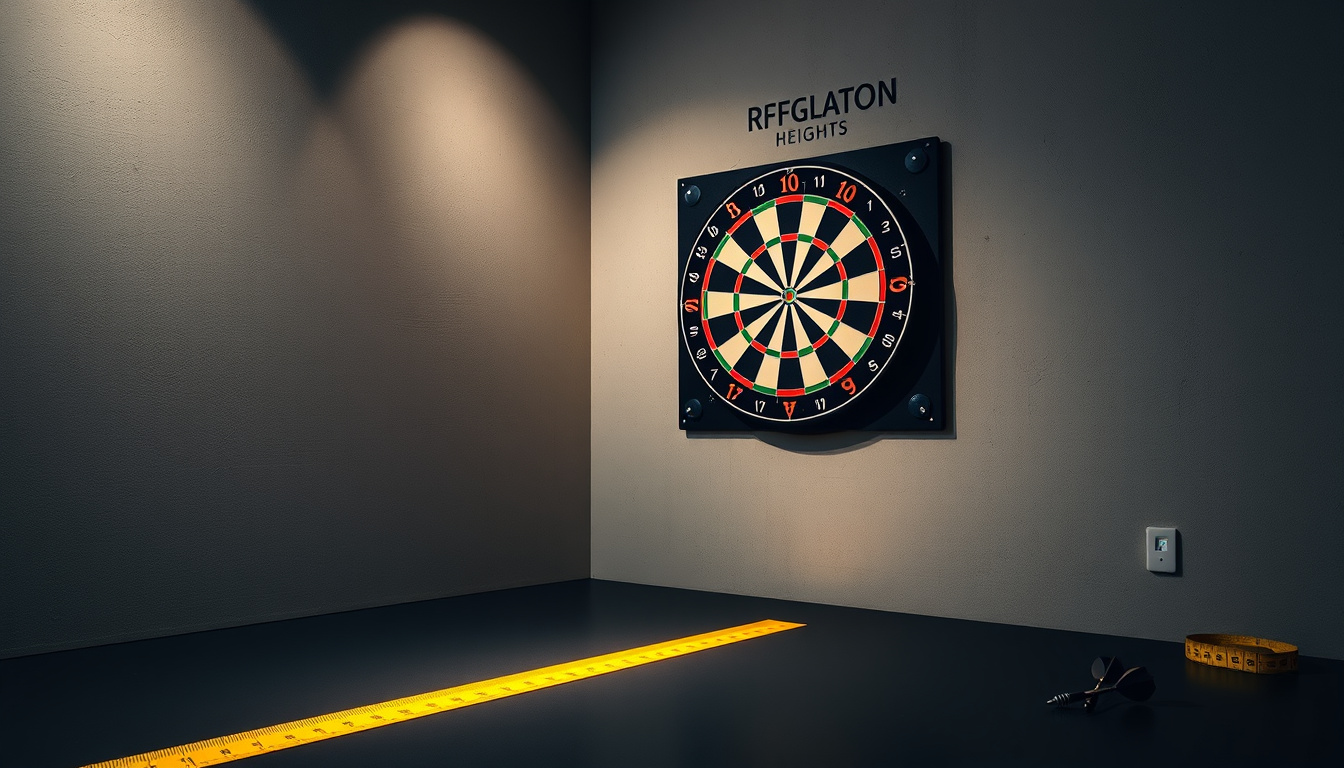
Getting the distance right is the foundation of any proper dartboard setup. The official dartboard distance, measured from the front face of the board to the oche (throw line), differs between steel tip and soft tip darts, while the height to the bullseye remains constant. Understanding these measurements is essential for both competitive play and consistent practice at home.
It is a common assumption among new players that a single measurement works for every board. In reality, the governing bodies have established specific distances for each dart type, and knowing the difference prevents common setup errors. This guide covers the official rules, explains how to measure accurately, and addresses the most frequent questions about dartboard distance.
Whether you are mounting a board in a home game room or preparing for league matches, the following information draws on regulations from the World Darts Federation, the Professional Darts Corporation, and other authoritative sources. All measurements are given in both metric and imperial units for convenience.
What is the official dartboard distance?
The official distance from the front face of the dartboard to the oche is 2.37 meters (7 feet 9¼ inches) for steel tip darts and 2.44 meters (8 feet) for soft tip darts. The height to the centre of the bullseye from the floor is always 1.73 meters (5 feet 8 inches), regardless of dart type.
| Measurement | Value |
|---|---|
| Steel tip distance (oche to board face) | 2.37 m (7 ft 9¼ in) |
| Soft tip distance (oche to board face) | 2.44 m (8 ft 0 in) |
| Dartboard height (floor to bullseye) | 1.73 m (5 ft 8 in) |
| Diagonal bullseye to oche (steel tip) | 2.93 m (9 ft 7½ in) |
- The official distance from the oche to the board face is 237 cm for steel tip and 244 cm for soft tip.
- The bullseye must be 173 cm from the floor for all standards.
- Always measure from the front of the board face to the back of the oche—never from the wall.
- Home setups can tolerate small deviations, but maintaining the standard distance improves practice consistency.
- The diagonal distance from the bullseye to the oche provides a reliable cross-check: 293 cm for steel tip, 300 cm for soft tip.
| Property | Metric |
|---|---|
| Steel tip distance (oche to board face) | 237 cm (7 ft 9.25 in) |
| Soft tip distance (oche to board face) | 244 cm (8 ft 0 in) |
| Height to bullseye | 173 cm (5 ft 8 in) |
| Diagonal bullseye to oche (steel) | 293 cm (9 ft 7.5 in) |
| Diagonal bullseye to oche (soft) | 300 cm (9 ft 10 in) |
| Standard oche width | Minimum 61 cm (2 ft) wide |
What is the correct dartboard height?
How high should the dartboard be from the floor?
The centre of the bullseye must be exactly 1.73 meters (5 feet 8 inches) above the floor. This measurement is universal for all standard dartboard types, including electronic, steel tip, and soft tip boards. Use a tape measure and mark the wall at this height before mounting.
Is the height the same for steel tip and soft tip?
Yes. The bullseye height of 1.73 m is identical for both steel tip and soft tip dartboards. The only variation in official setup concerns the horizontal throw line distance, not the vertical height.
For players using wheelchairs, the official dartboard height is lowered to 1.37 meters (4 feet 6 inches). The throwing distance (oche) remains the same as the standard setup. This accommodation is recognised by many national darts organisations.
How to measure the bullseye height?
Measure vertically from the floor to the exact centre of the bullseye. Use a spirit level to ensure the board is straight. If the wall is uneven, a leveler kit on the back of the board can correct alignment. Always double-check the height after mounting.
How to measure dartboard distance correctly?
What tools do I need to measure the distance?
A standard tape measure (at least 3 metres long) is sufficient. For greater accuracy, many players use a plumb bob or a string with a weighted object (like a spare dart) dropped from the bullseye to mark the floor point directly below the board face. A spirit level is also recommended for vertical alignment. For a full breakdown of mounting steps, refer to our guide on Dartboard height and distance.
How to set up the oche line?
The oche is a raised or clearly marked line on the floor. Measure horizontally from the front face of the dartboard to the back edge of the oche. For steel tip, that distance is 2.37 m; for soft tip, 2.44 m. A dart mat with a printed throw line simplifies the process and often accounts for the gap between the wall and the board face.
Always measure from the face of the dartboard, not from the wall. The board projects outwards, so using the wall can shorten the actual throwing distance by several centimetres. Dropping a plumb line from the bullseye to the floor helps locate the correct starting point.
Can I adjust the distance for home practice?
While official matches require exact measurements, home practice can tolerate small deviations—typically within 2–3 cm. A slightly shorter or longer throw line will not prevent skill development, but maintaining the standard distance ensures your practice replicates tournament conditions.
Are there different distances for steel tip vs soft tip darts?
What is the official soft tip distance?
Soft tip darts use an oche distance of 244 cm (8 feet) from the board face. This is 7 cm longer than the steel tip distance. The extra space accounts for the different sensor placement and electronic scoring systems commonly found on soft tip boards.
To verify your setup, measure diagonally from the centre of the bullseye to the oche. For steel tip, this diagonal should be 293 cm (9 ft 7¼ in); for soft tip, 299 cm (9 ft 9¾ in). This method is especially useful when walls are uneven or when you cannot measure directly from the board face.
Why are the distances different?
The longer throw line for soft tip darts originated from early electronic boards that required more space for the sensor array to register dart impacts accurately. Over time, this became the standard adopted by the World Darts Federation and national soft tip associations.
Which distance should I use at home?
If you own a steel tip board, use the 2.37 m distance. For electronic soft tip boards, use 2.44 m. Some home players with dual-purpose boards choose the soft tip distance as a compromise, but this is not official for steel tip play. Sticking to the rules of your primary game type is recommended. Brands like Shot Darts and Net World Sports provide setup guides that align with these standards.
What is the distance for ladies darts and home setups?
Are ladies distances official?
No. There are no separate dartboard distance rules for women in any major governing body. The same measurements apply to all competitors, regardless of gender. The misconception may arise from older informal play or from some local leagues that no longer exist.
What are common home setup mistakes?
The most frequent error is measuring from the wall rather than the board face. Another is using an inaccurate oche marker—a simple strip of tape that moves over time. Players also often forget to check the board is level vertically, which can affect throwing accuracy.
Should I use the professional distance for practice?
Yes. Professional tournaments use the exact distances described above, and practicing at the regulation oche distance builds muscle memory that transfers directly to competition. Even if your room is small, setting the line as close to the standard as possible is better than guessing.
History of dartboard distance standards
- 1900s – Early darts played with varying distances, typically around 8–9 feet, with no unified rule.
- 1920s – The British Darts Organisation standardised the steel tip distance at 7 ft 9¼ in (237 cm).
- 1970s – Soft tip darts gain popularity; electronic board manufacturers set the distance at 8 ft (244 cm).
- 1990s – The World Darts Federation (WDF) adopts the current height and distance rules.
- 2000s – The Professional Darts Corporation (PDC) reaffirms the same standards for all its events.
- 2025 – Current rules remain unchanged; modern setup guides include digital calculators and mobile apps.
Certainty vs. uncertainty in dartboard distances
| Established information | Information that remains unclear |
|---|---|
| The official distance for steel tip darts is fixed at 237 cm (7 ft 9¼ in) from board face to oche. | Soft tip distance is 244 cm (8 ft), but some local leagues may vary slightly. |
| The bullseye height is universally 173 cm (5 ft 8 in). | Ladies distances are not separately defined in official rules; some older sources suggest 7 ft 6 in, but modern rulebooks treat all genders equally. |
| Measurement must be taken from the board face, not the wall. | Home setups can tolerate small deviations (e.g., ±1 inch) without affecting practice, but official matches require exact measurement. |
Analysis: Why these distances matter
The 237 cm steel tip distance has a historical origin: it corresponds to the length of three standard pub floorboards used in 1920s Britain, which measured approximately 7 ft 9 in each. This practical measurement became formalised as the sport grew.
The diagonal measurement (bullseye to oche) provides a cross-check that ensures the board is hung correctly and that the throw line is neither too close nor too far. Many amateur players overlook the importance of this verification step.
Soft tip darts require a longer throw line of 244 cm because electronic boards contain sensors that need a consistent impact zone. The extra 7 cm reduces interference and improves scoring reliability. This difference is not arbitrary but based on engineering requirements of the boards themselves, a point echoed by resources like DartShopper.
What do the experts say?
For steel-tipped darts matches, the correct distance to stand from a dart board is 7ft 9¼in, or 237cm.
Net World Sports
The official distance from the dartboard when playing with steel tip dart are 237cm (7 feet, 9.25 inches) from the front of your dartboard to the back of the oche.
Shot Darts
The official dartboard distance is 2,37 meters (7 feet 9¼ inches).
DartShopper
What’s next for your dartboard setup?
Measure your existing setup using the diagonal method to verify accuracy. If you are marking a new oche, consider using a dart mat with a pre-printed throw line for convenience. For leagues and clubs, ensure the oche line is clearly marked and checked before each match. Manufacturers increasingly include measuring guides with new boards, but it is always worthwhile to double-check with a tape measure. For a full breakdown of mounting steps, see our guide on Dartboard height and distance.
Frequently asked questions
What is the distance from the dartboard to the oche for soft tip darts?
The official distance is 8 feet (244 cm) from the face of the board to the oche.
Can I use a different distance at home?
Yes, but using the official distance ensures you practice under standard conditions. A variation of a few centimetres may not affect casual play.
How do I measure the diagonal from bullseye to oche?
Measure from the centre of the bullseye diagonally to the back edge of the oche. The correct diagonal distance is 293 cm (9 ft 7.5 in) for steel tip and 300 cm (9 ft 10 in) for soft tip.
What if my room is too small for the official distance?
You can shorten the distance, but be aware it will change the throwing angle. Many home players use a distance of 7 ft or 8 ft as a compromise.
Are there separate rules for women’s darts?
No. Official rules use the same distance for men and women. The misconception may come from older informal play.

Sophie Kendall is Culture & Events Editor at DailyCity.co.uk, covering restaurants, nightlife, theatre, exhibitions, festivals and city life.