Determining whether eggs remain safe to eat requires more than glancing at the carton date. While the sell-by date provides a baseline, eggs often maintain quality and safety well beyond this timestamp when stored correctly.
Several reliable methods exist to assess freshness without risking your health. From simple water tests to sensory inspections, these techniques help distinguish between slightly older but edible eggs and those that have truly spoiled.
This guide examines the science behind egg deterioration and provides actionable steps to evaluate your eggs before cracking them open.
How Can You Tell If Eggs Are Bad? Key Freshness Tests
Float Test
Sinks horizontally for freshness; tilts or floats indicates aging
Smell Test
Neutral odor indicates safety; sulfur means discard immediately
Visual Check
Crack inspection reveals yolk firmness and white consistency
Date Tracking
Pack dates indicate true age versus sell-by labels
- The Egg Float Test effectively indicates freshness levels but cannot detect bacterial contamination alone
- Proper refrigeration extends shelf life four to five times longer than room temperature storage
- Sell-by dates typically allow three to five additional weeks of safety margin when eggs remain cold
- Air cell expansion directly correlates with moisture loss and aging
- Sulfur odor detection remains the most definitive spoilage indicator
- Cracked shells accelerate bacterial entry and warrant immediate disposal
| Indicator | Fresh Status | Compromised Status |
|---|---|---|
| Water Position | Sinks flat | Floats or stands upright |
| Odor | Neutral | Sulfur/rotten smell |
| White Texture | Thick, cloudy | Thin, watery, spreading |
| Yolk Appearance | Round, firm, bright | Flat, pale, broken |
| Air Cell Size | Less than 1/8 inch | Exceeds 1/4 inch |
| Shell Condition | Intact, dry | Cracked, slimy, powdery |
Do Bad Eggs Float or Sink in Water?
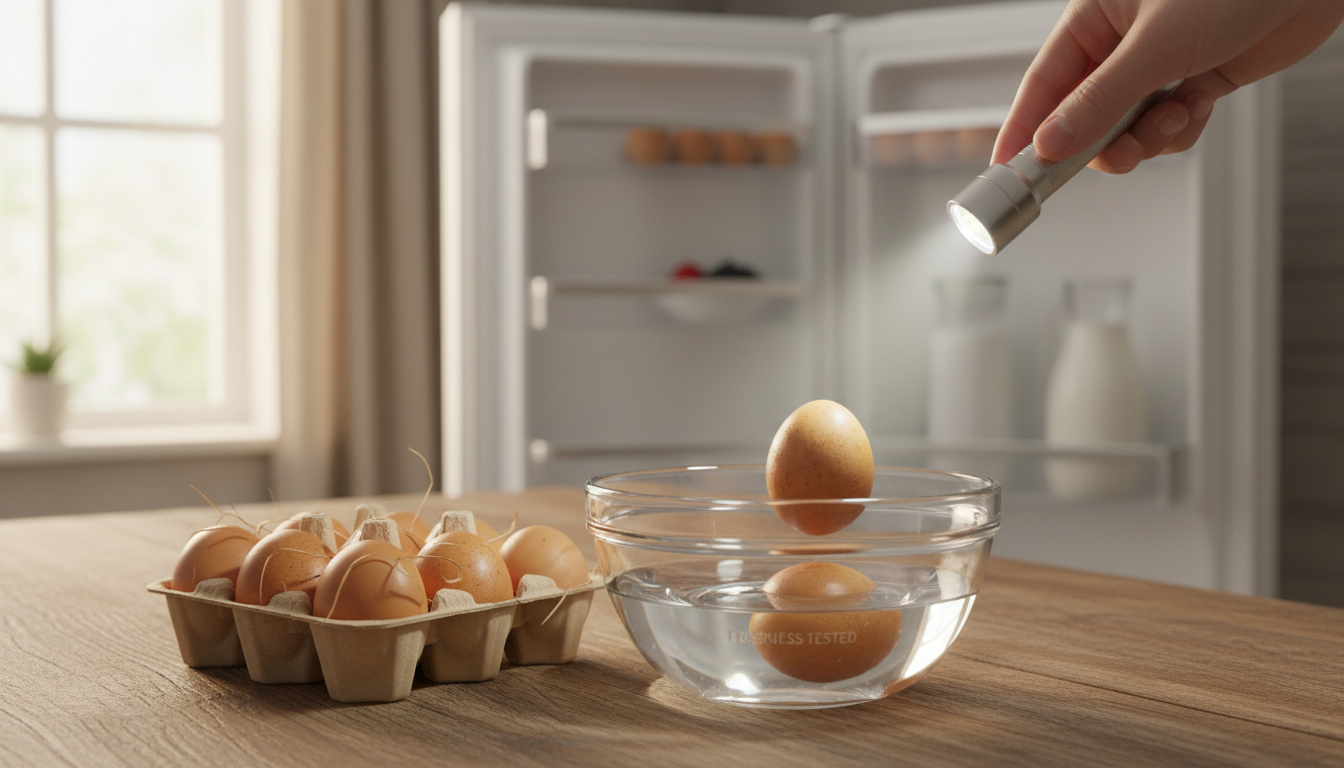
Fresh eggs contain minimal air pockets and high moisture content, causing them to sink in water. As eggs age, moisture evaporates through the porous shell and replaces with air, increasing buoyancy according to egg physics demonstrations.
When submerged in cold water, a truly fresh egg settles horizontally at the bottom. An egg that tilts upward or stands on its end indicates aging but not necessarily spoilage. Complete floating suggests significant air cell expansion.
Can You Eat Eggs That Float?
Floating indicates advanced age rather than automatic contamination. Many floating eggs remain safe to eat after cracking and verifying absence of sulfur odor. However, the float test alone cannot confirm safety or detect bacterial growth.
The float test reveals air cell expansion and age but cannot detect bacterial growth. An egg may sink while harboring pathogens, or float while remaining edible. Always combine with smell verification.
How Long Do Eggs Last and What Are Signs of Spoilage?
Refrigerated eggs maintain quality for four to five weeks beyond the pack date, according to USDA guidelines on shell eggs. The “Best By” date stamped on cartons typically reflects 75 days from lay, providing a substantial safety buffer.
Can You Eat Three-Week-Old Eggs?
Eggs refrigerated continuously remain safe at three weeks, though quality begins declining. The University of Minnesota Extension confirms proper cold storage maintains safety for four to five weeks. At three weeks, perform float and smell tests before consuming.
What Does a Bad Egg Smell Like?
The smell test provides the most definitive spoilage detection. Fresh eggs emit a neutral, slightly mineral odor. Any sulfur smell, reminiscent of rotten eggs or hydrogen sulfide, indicates bacterial breakdown and mandates immediate discarding.
Sometimes odor penetrates the shell, but often you must crack the egg onto a clean plate to detect off-smells. The 5 Ways to Test the Freshness of Your Eggs emphasizes that visual and olfactory checks together provide the safest assessment.
Visual Indicators of Spoilage
After cracking, examine the white and yolk carefully. Fresh albumen stands tall and compact, while older eggs spread thin like water. The yolk should appear bright and domed; flattening suggests membrane weakening.
Discard eggs showing dark brown or black spots, which indicate fungal or bacterial contamination. While blood spots on the yolk pose no safety risk and occur naturally, pinkish whites or iridescent surfaces signal bacterial growth and spoilage.
How to Store Eggs Properly for Maximum Freshness
Proper storage dramatically extends viability. The FDA recommends maintaining eggs at 40°F (4°C) or below, stored in their original carton on interior shelves rather than the door.
Original Carton Importance
The carton prevents moisture loss and protects against odor absorption from strong-smelling foods like onions or garlic. It also displays the pack date, which indicates the day of the year the eggs were washed and graded.
Eggs left at room temperature for over two hours enter the danger zone where bacteria multiply rapidly. Return eggs to refrigeration immediately after use.
University of Minnesota Extension confirms that refrigerated eggs retain quality weeks beyond sell-by dates. Consistent cold temperatures slow air cell expansion and albumen thinning storage tests demonstrate.
How Does Egg Composition Change Over Time?
- Days 0-3: Air cell measures less than 1/8 inch; albumen thick and compact; yolk membrane firm and high
- Week 2-3: Air cell expands to approximately 1/8 inch; whites begin thinning slightly; yolk remains round but less firm
- Week 4-5: Air pocket grows noticeably larger; whites spread widely when cracked; yolk flattens and may break easily when transferred
- Week 6+: Significant buoyancy in water tests; pronounced air cell; increased risk of bacterial penetration through weakened membranes
This progression occurs because eggshells contain approximately 17,000 pores allowing air and moisture exchange, as documented in poultry science research.
What Do We Know With Certainty About Egg Freshness?
| Established Facts | Uncertain Variables |
|---|---|
| Air cell expansion correlates directly with egg age | Exact bacterial load without laboratory testing |
| Sulfur odor definitively indicates spoilage | Individual immune response to marginal eggs |
| Refrigeration at 40°F prevents rapid bacterial growth | Precise shelf life without pack date verification |
| Cracked shells increase contamination risk | Visual color variations in farm-fresh versus commercial eggs |
Why Do Eggs Deteriorate Inside the Shell?
Egg deterioration stems from biological and physical processes beginning the moment the hen lays the egg. The porous shell, designed to allow the chick to breathe during development, becomes the primary vector for quality loss in unfertilized table eggs.
Moisture migrates outward while air infiltrates inward, enlarging the air cell at the blunt end. Simultaneously, the protective bloom or cuticle washes away during commercial processing, accelerating gas exchange. Over weeks, the thick albumen breaks down into thinner fluid, and the yolk membrane weakens, increasing susceptibility to bacterial penetration.
These changes occur even under refrigeration, though cold temperatures significantly slow the rate of deterioration.
What Do Food Safety Authorities Recommend?
According to USDA guidelines on shell eggs, properly refrigerated eggs maintain safety and quality for three to five weeks after purchase. The FDA emphasizes discarding any egg exhibiting unusual odors regardless of packaging dates.
Final Verification: Are Your Eggs Safe?
Combine the Egg Float Test with olfactory verification for the safest assessment. When uncertainty persists—whether from cracks, off-colors, or ambiguous smells—discard the egg. The cost of replacement far outweighs the risk of foodborne illness.
Frequently Asked Questions
What color yolk indicates fresh eggs?
Fresh yolks appear bright yellow to orange with a firm, domed structure. Pale or flat yolks indicate aging but not necessarily spoilage.
Is it safe to eat cracked eggs?
Cracked shells allow bacterial entry and accelerate spoilage. The FDA recommends discarding cracked eggs rather than risking contamination.
Can you eat eggs that float?
Floating indicates age, not automatic spoilage. Crack and smell before using; absence of sulfur odor suggests edibility despite age.
How long do eggs last in the refrigerator?
Properly refrigerated eggs maintain quality for four to five weeks beyond the pack date, sometimes longer.
Do bad eggs always smell?
Most spoiled eggs develop a distinct sulfur odor, but early bacterial contamination might not produce immediate smells. Cracking for inspection remains essential.
Should eggs be washed before storage?
Commercial eggs arrive pre-washed. Washing at home removes the protective cuticle and increases spoilage risk. Store them unwashed in the carton.
Why are fresh eggs harder to peel?
The membrane between the shell and white adheres tightly in very fresh eggs. Slightly older eggs release more easily from their shells when hard-boiled.

Daniel Mercer is Urban Affairs Editor at DailyCity.co.uk, covering councils, City Hall, planning, transport and infrastructure across London and major UK cities.