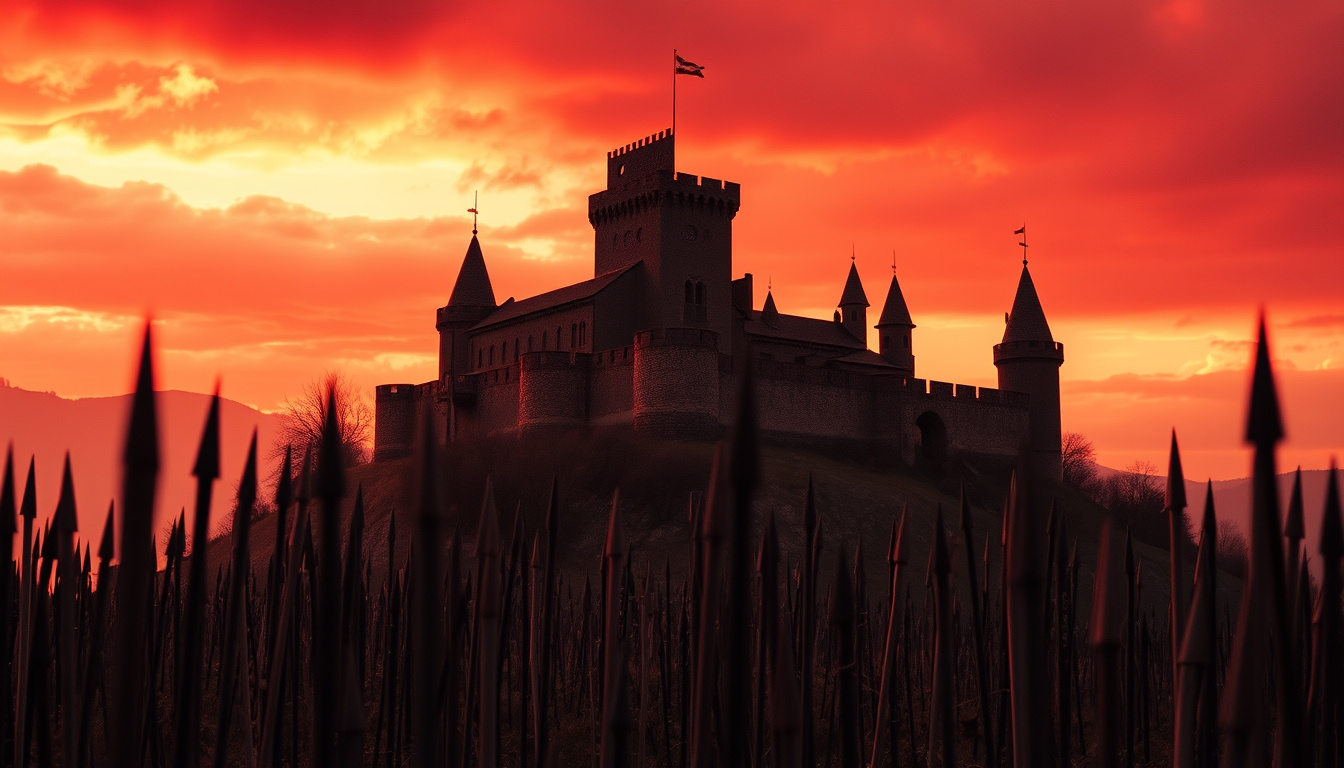
Few historical figures have undergone a transformation as dramatic as that of Vlad III Drăculea. Known to history as Vlad the Impaler, the 15th-century Voivode of Wallachia has become synonymous with the world’s most famous vampire. But the man behind the legend was no creature of the night. He was a warrior prince who ruled with an iron fist, fought the Ottoman Empire, and whose name was co-opted by a novelist to create a monster that would eclipse the human truth.
Born around 1431 in the Transylvanian town of Sighișoara, Vlad was the son of Vlad II Dracul, a member of the Order of the Dragon. This chivalric order was dedicated to fighting the Ottoman threat, and its dragon emblem would give rise to the name that would one day terrify the world. The young Vlad spent years as a hostage of the Ottoman Sultan, an experience that shaped his ruthless worldview.
His life was marked by three separate reigns over Wallachia, each defined by brutal conflict, shifting alliances, and a chillingly effective method of punishment. His story is a tangle of verified fact, medieval propaganda, and modern fiction.
Who Was Vlad the Impaler?
Full Name
Vlad III Drăculea (Vlad the Impaler)
Lifespan
c. 1431 – 1476/77
Ruled
Wallachia (three times: 1448, 1456–1462, 1476)
Known For
Extreme cruelty (impalement); inspiration for Bram Stoker’s Dracula
Vlad III was a son of the conflict between Christian Europe and the Islamic Ottoman Empire. His father, Vlad II, was a respected ruler who was inducted into the Order of the Dragon, a fact that gave the family its nickname. The Romanian word “Dracul” means both “dragon” and “devil,” so “Dracula” translates to “son of the dragon” or “son of the devil,” depending on the interpretation.
- Historical reputation: Vlad’s reputation for brutality is largely derived from propaganda spread by his enemies, particularly the Saxons and the Ottoman Turks.
- Vampire connection is weak: The link to vampirism is historically tenuous; Bram Stoker borrowed the name “Dracula” but not the personality of the historical prince.
- Uncertain death: Most sources say he was killed in battle against the Ottomans around December 1476, but his body was never definitively identified.
- Pop culture hybrid: Modern portrayals in films and games like Castlevania often combine historical Vlad with supernatural traits, creating a composite character far from the human original.
| Fact | Detail |
|---|---|
| Nickname | Vlad Țepeș (Vlad the Impaler) – Romanian for “impaler” |
| Father | Vlad II Dracul (member of the Order of the Dragon) |
| Name origin | “Dracula” means “son of Dracul” (dragon/devil) |
| Reign start | First reign in 1448 (age ~17) |
| Major enemy | Mehmed II, Ottoman Sultan |
| Infamous event | The Night Attack of Târgoviște (1462) |
| Death | Killed in battle near Bucharest, c. 1476 |
| Legacy | National hero in Romania; horror icon worldwide |
What Does Țepeș Mean?
The suffix added to his name, Țepeș, is Romanian for “the Impaler.” It was a grim title earned through his preferred method of execution. During his second reign (1456–1462), Vlad impaled thousands of captured Turkish soldiers, Saxon merchants, and internal rivals to project power and deter rebellion. The sight of a “forest of the impaled” was a calculated act of psychological warfare.
Why Is He Called Vlad the Impaler?
The nickname was both a description and a weapon. Vlad’s use of impalement was so extreme that it became his defining characteristic in European chronicles. Medieval sources describe him impaling tens of thousands of people. Modern historians debate the exact numbers, with some suggesting the figures were greatly exaggerated by his detractors, particularly after his imprisonment in Hungary. Regardless of the count, the method was exceptionally brutal.
Why Is Vlad Dracula Linked to Vampires?
The connection between the historical Vlad Dracula and the iconic vampire is a fascinating case of literary invention. The name “Dracula” itself was a perfect fit for a supernatural predator. Bram Stoker’s novel Dracula, published in 1897, drew loosely on Vlad’s name and reputation for cruelty, but it transformed him into a vampire and supernatural figure.
Did Bram Stoker Base Dracula on Vlad the Impaler?
The commonly held belief that Stoker conducted deep historical research on Vlad III is largely a myth. Stoker borrowed the name and the Transylvanian setting from historical footnotes. He read about the “Voivode Dracula” who fought against the Turks, but the vampire’s personality, powers, and weaknesses were drawn from European folklore, not the life of the Wallachian prince. The historical Vlad was a human warrior and ruler, not a creature of the night.
How Is Vlad Dracula Related to Bram Stoker’s Dracula?
The relationship is one of naming and atmosphere, not biography. Stoker’s notes reveal he found the name “Dracula” in a book on Wallachian history and liked it because it meant “devil” in Romanian. He combined that resonant name with elements of vampire folklore from Transylvania and other regions. Pop culture has since cemented Vlad as the archetypal blood-drinking vampire, despite the weak historical link.
Much of Vlad’s terrifying reputation was deliberately manufactured by Saxon merchants in Transylvania. After Vlad attacked their trading towns and impaled thousands, they printed early German pamphlets detailing his cruelties. These “news” stories spread across Europe, painting him as a monstrous tyrant. This 15th-century propaganda campaign was remarkably effective and later influenced Stoker’s depiction.
How Did Vlad Dracula Die?
The death of Vlad the Impaler is as shrouded in uncertainty as much of his life. Historical accounts agree that he died in battle in late 1476, but the precise details remain contested. He had recently been crowned for a third and final time in November 1476, but within weeks, he was dead.
What Was the Cause of Vlad the Impaler’s Death?
The most widely cited account states that he was killed during a battle against the Ottomans. However, there are conflicting versions of the event. In one detailed version, he won the battle but was killed in the chaos afterward when his own men, confused in the aftermath, mistook him for an enemy and pierced him with lances after he had already killed five attackers.
Another version simply states that he was pierced through by many lances during the battle’s confusion. His body was never recovered for certain burial. A headless, headless corpse was reportedly taken to Constantinople by the Ottomans as proof of his death, but this was never independently verified. The lack of a confirmed burial site has only fueled the legend.
Where Is Vlad Dracula Buried?
Tradition and popular lore suggest he is buried at Snagov Monastery, near Bucharest. An archaeological excavation in the 1930s found a headless skeleton presumed to be his, but no definitive proof exists. Other theories suggest his remains were simply discarded or lost. The uncertainty around his final resting place adds a final layer of mystery to his story.
Despite the fictional vampire myth, the manner of Vlad’s death was fitting for a warrior prince. He died violently in combat at the age of around 45, having spent his life fighting for his throne. The confusion that led to his being killed by his own men, if true, adds a tragic irony to a life filled with calculated cruelty.
Vlad the Impaler vs. Mehmed II: The Historical Conflict
Vlad’s most famous military confrontation was with Sultan Mehmed II, the conqueror of Constantinople. The conflict was a clash of two equally ambitious and ruthless leaders. Vlad’s goal was to resist Ottoman domination of Wallachia, a vassal state that paid tribute to the Sultan.
What Happened Between Vlad Dracula and Mehmed II?
The tension escalated in 1461 when Vlad stopped paying tribute to the Ottoman Empire. He then launched a devastating campaign, massacring Ottoman troops and civilians in Bulgarian towns under Ottoman control. Sultan Mehmed II, enraged by this defiance, prepared a massive invasion force to crush Vlad and install his more compliant brother, Radu the Handsome, on the Wallachian throne.
What Was the Night Attack at Târgoviște?
In June 1462, as the Ottoman army of over 100,000 men marched on Wallachia, Vlad executed a daring and desperate maneuver. With an army of perhaps 30,000 men, he launched a surprise night attack on the Sultan’s camp near the capital of Târgoviște. The assault sowed immense confusion. Ottoman sources admit to heavy losses and a near-capture of the Sultan himself. While the attack did not destroy the Ottoman army, it was a significant psychological blow to one of the most powerful men in the world.
Vlad’s tactics during this war were extreme, as detailed in historical timelines. He employed a scorched-earth policy, poisoning wells and burning crops to deny supplies to the invading force. Most famously, he turned the battlefield into a forest of the impaled. When Mehmed’s army arrived at the capital, they found approximately 20,000 impaled Turkish prisoners surrounding the city. The sight was so horrifying that it reportedly caused the Sultan’s commanders to vomit, but it also hardened Mehmed’s resolve to replace Vlad.
The “forest of the impaled” outside Târgoviște featured victims that included captured Turkish soldiers but also Saxon traders and Wallachian boyars. The method was exceptionally slow and agonizing. While medieval chronicles claim tens of thousands of impalements, modern historians debate the numbers, suggesting they may have been exaggerated for propaganda purposes by both Vlad’s enemies and his own court.
Vlad Dracula in Pop Culture: Books, Movies, and Castlevania
The historical Vlad has been largely overshadowed by his fictional counterpart, but he continues to appear in various media forms. Modern pop culture often blends the real prince with the vampire myth, creating a hybrid character that is neither one nor the other. This has made separating fact from fiction even more difficult for the general public.
What Books Are About Vlad Dracula?
The most famous fictional work is Bram Stoker’s Dracula, which spawned the entire genre. For non-fiction, the definitive biography is Dracula: Prince of Many Faces by Radu Florescu and Raymond T. McNally. This work aims to separate the historical figure from the myth. The novel The Historian by Elizabeth Kostova also weaves a modern story with the search for the historical Vlad.
What Movies Feature Vlad Dracula?
Numerous films have depicted Vlad, with varying degrees of historical accuracy. Notable examples include Dracula Untold (2014), which presents an origin story for the vampire, and the classic Nosferatu (1922), which took inspiration from Stoker’s novel. Historical documentaries like Dracula: A Biography of Vlad the Impaler focus on the real man.
Is Vlad Dracula in Castlevania Accurate?
The character of Dracula in the Castlevania franchise, including the Netflix animated series, is a clear example of the hybrid figure. He is portrayed as a tragic, super-powered vampire lord who is also a brilliant tactician and grieving husband. The series borrows his name, his conflict with the church, and his status as a ruler of Wallachia, but it adds supernatural abilities and a complex anti-hero persona that is entirely fictional. It is entertainment, not a historical portrait.
Timeline of Vlad the Impaler’s Life and Reign
- – Born in Sighișoara, Transylvania, to Vlad II Dracul.
- – Held hostage by the Ottoman Empire along with his brother Radu.
- – First brief reign as Voivode of Wallachia.
- – Second reign begins after killing his rival Vladislav II.
- – Night Attack on the Ottoman camp at Târgoviște; conflict with Mehmed II.
- – Captured by Matthias Corvinus of Hungary, imprisoned for about 12 years.
- – Third and final reign; killed in battle (December 1476).
What Is Certain and What Remains Unclear?
| Established Information | Information That Remains Unclear |
|---|---|
| Birth year (c. 1431, though exact date unknown). | Location of death (likely near Bucharest or Snagov; body never confirmed). |
| He was a Voivode of Wallachia who fought against Ottoman expansion. | The exact number of impalements (medieval chronicles claim tens of thousands; modern historians debate the number). |
| His preferred method of execution was impalement. | The precise manner of his death (killed by his own men or by the Ottomans). |
| The name “Dracula” comes from his father’s Order of the Dragon. | The vampire connection (none exists historically; it is purely a literary creation). |
How Did a 15th-Century Prince Become a Monster?
Vlad Dracula’s elevation to the king of all vampires is a tale of 15th-century propaganda meeting 19th-century fiction. His brutal methods, while shocking, were not entirely uncommon for a medieval ruler trying to consolidate power in a volatile region. However, the scale of his terror was exceptional. His name, meaning “son of the devil,” was perfectly suited for a horror novel.
Bram Stoker’s Dracula (1897) was inspired by Transylvanian folklore and the historical figure’s cruel reputation, but Stoker did minimal historical research. He created a character that fit the anxieties of Victorian England, a foreign, aristocratic predator preying on the innocent. The success of the novel, and later films, cemented the name Dracula in the global imagination as the archetypal vampire. In Romania, Vlad is often remembered as a national hero, a defender of Christendom against the Ottoman hordes, and many Romanians resent the vampire association that overshadows his political and military legacy.
What Are the Key Sources and Quotes About Vlad the Impaler?
“He was the bravest and the most righteous of all Christian princes.”
– Chronicler Laonikos Chalkokondyles (15th century)
“Vlad the Impaler was a medieval prince whose bloodthirsty acts inspired the world’s most famous vampire.”
– LiveScience, 2025
“Dracula is the name of the Devil, for so he was called by the people.”
– Anonymous Saxon pamphlet, 1463
What Does the Future Hold for the Study of Vlad Dracula?
Recent archaeological investigations near Snagov monastery may shed light on Vlad’s final resting place. Ongoing historical research continues to separate myth from fact regarding his reign and death. Pop culture interest remains high with new adaptations on the horizon. The real Vlad III will likely remain a figure of fascination, a complex human being whose life was so terrifying that it inspired a legend far greater than the man himself.
Frequently Asked Questions About Vlad Dracula
What does ‘Tepes’ mean?
Tepes (Țepeș) is Romanian for ‘impaler,’ referring to Vlad’s preferred method of execution.
Was Vlad Dracula actually a vampire?
No. He was a 15th-century prince with no supernatural traits. The vampire association is purely fictional, originating from Bram Stoker’s novel.
How is Vlad Dracula related to Count Dracula?
Bram Stoker took the name ‘Dracula’ from historical records and the Transylvanian setting, but the character is largely fictional.
Did Vlad Dracula really impale thousands of people?
Historical accounts vary; some chronicles claim up to 100,000, but modern historians estimate the number is likely greatly exaggerated.
What books are about Vlad Dracula?
Notable nonfiction includes ‘Dracula: Prince of Many Faces’ by Florescu and McNally. Fiction includes Bram Stoker’s ‘Dracula’ and Elizabeth Kostova’s ‘The Historian.’
Why is he called ‘Dracula’?
It means ‘son of Dracul,’ referring to his father, Vlad II, who was a member of the Order of the Dragon. ‘Dracul’ means dragon or devil in Romanian.
When did Vlad the Impaler die?
He was killed in battle around December 1476 (some sources cite 1477).

Daniel Mercer is Urban Affairs Editor at DailyCity.co.uk, covering councils, City Hall, planning, transport and infrastructure across London and major UK cities.