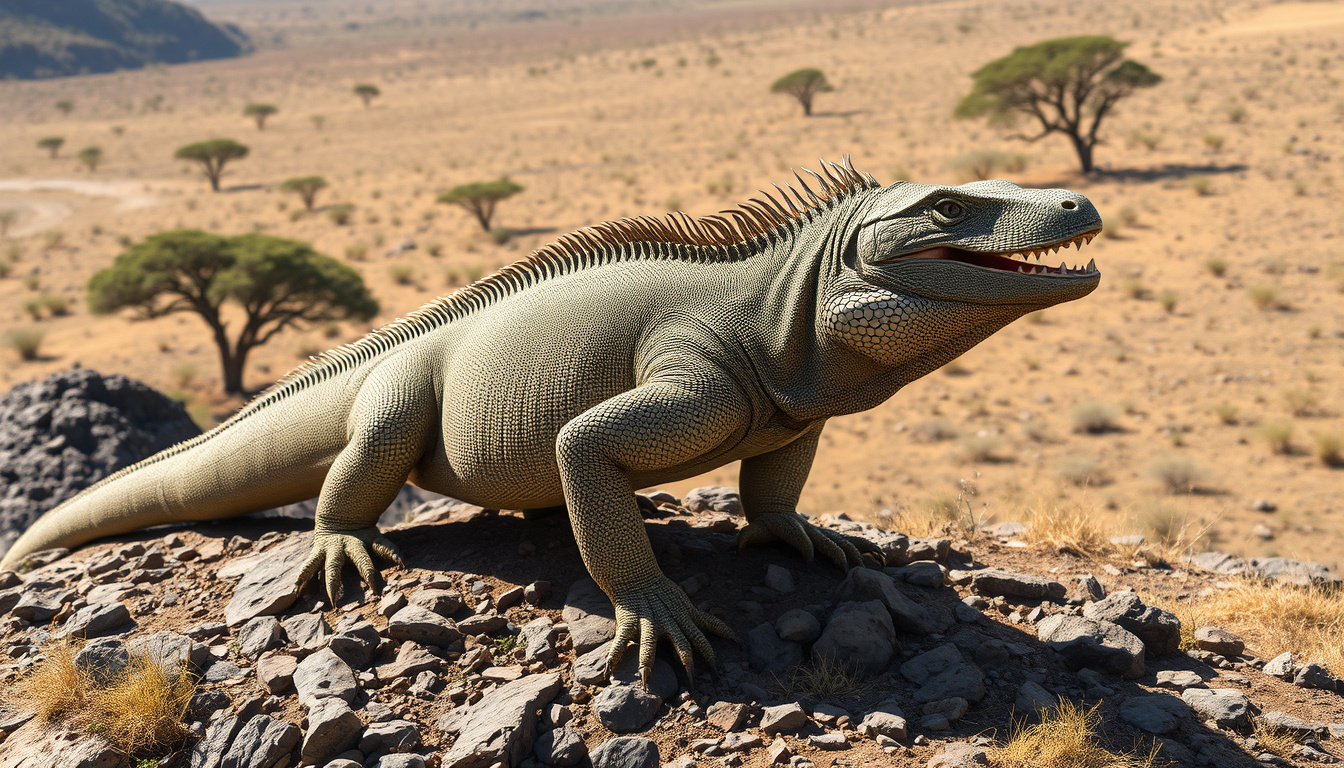
Komodo dragons (Varanus komodoensis) are the world’s largest living lizards and an apex predator restricted to a small group of Indonesian islands. They are powerful ambush hunters—not suitable pets—and are classified as Endangered, chiefly because of their extremely limited range, prey depletion, habitat loss and climate-driven sea-level rise.
These monitor lizards belong to the family Varanidae, the same broad family that includes crocodile monitors, lace monitors and water monitors. Found only in Indonesia, they have fascinated scientists and the public since their formal documentation in the early twentieth century, and research continues to reshape what we know about how they kill.
How Big Do Komodo Dragons Get?
Adult males can reach about 3 meters (10 ft) and roughly 135–150 kg (300–330 lb), though most wild adults weigh closer to 70 kg (154 lb). The largest verified specimen measured 3.13 meters and weighed 166 kg, according to Britannica. Captive individuals can live for several decades, while exact wild longevity is harder to establish.
Key insights about Komodo dragons:
- Komodo dragons are the largest extant lizards, reaching up to 3 meters in length and 90 kg in weight.
- They possess venom glands that cause rapid blood loss and shock in prey, a recent scientific discovery that replaced the earlier “bacteria theory.”
- Despite their fearsome reputation, attacks on humans are rare; most incidents occur when people provoke or corner them.
- Komodo dragons are only found on a few Indonesian islands and are classified as Endangered due to habitat loss and human activity.
- Their top running speed is about 20 km/h (12 mph), but they are ambush predators, not pursuit hunters.
Komodo dragon fast facts
| Metric | Value |
|---|---|
| Common Name | Komodo Dragon (also Komodo monitor) |
| Scientific Name | Varanus komodoensis |
| Class | Reptilia |
| Order | Squamata |
| Family | Varanidae |
| Average Length | 2.6–3 meters (8.5–10 feet) |
| Average Weight | 70–90 kg (150–200 lbs) |
| Top Speed | 20 km/h (12 mph) |
| Venom Type | Venomous (toxins in saliva) |
| Diet | Carnivore – deer, pigs, water buffalo, carrion |
| Conservation Status | Endangered (IUCN Red List) |
| Estimated Wild Population | 1,400–2,000 adults |
What Do Komodo Dragons Eat and How Do They Hunt?
Komodo dragons are opportunistic carnivores and scavengers. Their diet changes with age, and their hunting style relies more on patience and precision than on raw endurance.
What Is the Diet of a Komodo Dragon?
Their prey includes:
- Invertebrates, birds and small reptiles, especially for juveniles
- Rodents and other small mammals
- Wild pigs and deer
- Water buffalo and horses
- Carrion
- Smaller Komodo dragons, including cannibalism among adults and juveniles
- Occasionally humans
According to the Smithsonian National Zoo, they may consume as much as approximately 80% of their body weight in one feeding. Juveniles spend more time in trees, where they avoid adults that may otherwise prey on them.
How Do Komodo Dragons Kill Their Prey?
Komodo dragons generally hunt through ambush, remaining motionless near game trails or water sources and waiting for suitable prey. They can charge suddenly, targeting vulnerable areas such as the legs, underside or throat. They also scavenge carcasses and use a strong sense of smell to locate carrion from considerable distances.
Komodo dragons possess venom glands, contrary to the older popular belief that their lethality came solely from bacteria in their mouths. Their venom contains compounds that can lower blood pressure, interfere with clotting and promote prolonged bleeding, contributing to shock and incapacitation. The discovery was published in the Journal of Experimental Biology in 2009.
Their teeth are short, recurved and serrated. During an attack, the dragon bites and pulls or tears, allowing venom to enter through wounds. The bite is only one part of the weapon system: strong neck muscles, claws, body weight and blood loss all contribute to subduing prey. A bite does not necessarily kill instantly; escaping prey may later weaken from blood loss, injury and shock, after which the dragon can track or reclaim it.
The 2009 discovery of venom glands in Komodo dragons overturned decades of belief that mouth bacteria alone caused prey death. The venom’s anticoagulant and blood-pressure-lowering effects are now considered central to their hunting strategy.
In terms of speed, their maximum short-burst pace is approximately 20 km/h (12 mph), according to Discover Wildlife. That is fast enough to make close approaches dangerous, but they are not endurance runners. Acceleration, low body posture, claws and ambush tactics matter more than sustained speed.
Are Komodo Dragons Dangerous to Humans?
Komodo dragons have attacked and killed people, though attacks are uncommon and reliable long-term statistics are limited. One report from Komodo National Park recorded 24 attacks between 1974 and 2012, including five fatalities, as reported by Discover Wildlife.
When Do Attacks on Humans Occur?
Risk increases when people:
- Approach or feed dragons
- Walk alone near carcasses or feeding sites
- Ignore park guides and barriers
- Enter areas where dragons are resting or defending food
- Underestimate their ability to sprint
A person should never attempt to touch, corner, photograph at close range or feed a wild Komodo dragon.
Komodo dragons can sprint at up to 20 km/h in short bursts and deliver a bite that combines serrated teeth with venom that prevents clotting. Visitors to Komodo National Park should always stay with authorized guides and keep a safe distance from any dragon.
Can You Have a Komodo Dragon as a Pet?
Komodo dragons are not appropriate pets. According to Zoo Barcelona, they are dangerous to humans because of their raw strength and venomous bite, and they require highly specialized conditions. They grow to enormous size, have complex dietary and environmental needs, and retain predatory instincts even in captivity. Keeping them privately is heavily restricted or prohibited in many jurisdictions, and illegal demand for exotic reptiles can harm wild populations. Unlike many smaller monitor lizards, Komodo dragons cannot be responsibly managed as household animals.
Where Do Komodo Dragons Live?
Are Komodo Dragons Only Found on Komodo Island?
The species is endemic to Indonesia and is found on Komodo, Rinca, Flores, Gili Dasami and Gili Motang, according to Wikipedia. They are capable swimmers and can move between nearby islands, although their distribution is constrained by geography and prey availability.
What Is the Natural Habitat of the Komodo Dragon?
Their preferred environments include hot, dry savanna, open grassland, scrub, seasonal woodland and low-elevation tropical forest. These island landscapes are remote and demand careful planning from anyone visiting them.
Komodo dragons live on just a few Indonesian islands, not across the entire archipelago. This extraordinarily limited distribution is one of the main reasons the species is considered Endangered.
For outdoor travelers interested in expedition planning in demanding landscapes, a comparable level of preparation is covered in Scafell Pike – Complete Guide to Height, Routes and Weather.
How Was the Komodo Dragon Discovered?
- – First European documentation by Dutch lieutenant van Steyn van Hensbroek.
- – Formal scientific description by Peter Ouwens, director of the Bogor Zoological Museum.
- – First live Komodo dragons exhibited at the London Zoo.
- – Komodo National Park established to protect the species.
- – Komodo National Park designated a UNESCO World Heritage Site.
- – Venom glands discovered, overturning the theory that bacteria alone caused prey death.
- – Listed as Endangered on the IUCN Red List due to climate change and habitat loss.
- – Population estimates show fewer than 2,000 mature individuals remain in the wild.
The history of the Komodo dragon shows how persistence and curiosity drive scientific progress — the same qualities recognized in Tim Peake – the British Astronaut Who Made History.
What Is Known and What Remains Uncertain About Komodo Dragons?
| Established information | Information that remains unclear |
|---|---|
| It is now confirmed that Komodo dragons have venom glands that produce toxins causing hypotension, blood loss and shock. The earlier theory of fatal bacterial infection has been discredited. | Exact population figures vary; estimates range from 1,400 to 2,000 mature individuals. Ongoing monitoring is needed. |
| Venom is the primary killing mechanism; the dragon bites and then follows the prey until it collapses. The bite alone is rarely instantly fatal. | No credible scientific efforts to clone Komodo dragons have been announced; reports of such efforts remain pure speculation in media. |
| Documented attacks on humans exist but are uncommon. Most involve provoked dragons or encroachment into villages. | Long-term attack statistics are limited, and reliable data beyond the 1974–2012 report from Komodo National Park are scarce. |
| Fatalities from Komodo dragon attacks are extremely rare; only a handful have been recorded in the last century. | Exact wild longevity is difficult to establish; captive individuals can live for several decades. |
How Do Komodo Dragons Compare With Crocodiles and Other Monitor Lizards?
A comparison depends heavily on species and size. A large saltwater or Nile crocodile would generally outweigh and overpower a Komodo dragon, especially in water. A small or juvenile crocodile could be vulnerable to a large adult dragon on land.
| Feature | Komodo dragon | Crocodile |
|---|---|---|
| Main habitat | Dry island savanna, woodland and forest | Rivers, lakes, wetlands, estuaries and coasts |
| Typical hunting style | Ambush, biting, tearing and venom-assisted blood loss | Ambush, crushing bite and drowning |
| Speed on land | Up to about 20 km/h in short bursts | Species-dependent; some can move rapidly for short distances |
| Water ability | Good swimmer, but primarily terrestrial | Highly specialized aquatic predator |
| Bite function | Serrated teeth, tearing injuries and venom | Deep puncture and crushing force |
| Likely advantage | On dry land against a smaller crocodile | In water or against a large adult crocodile |
A large crocodile would normally have the advantage in bite force, armor, mass and aquatic combat. A Komodo dragon’s advantages are mobility on land, agility and venom, particularly against smaller reptiles or mammals.
Komodo Dragon vs Other Monitor Lizards
The Komodo dragon is itself a monitor lizard and the largest living member of that group. According to Discover Magazine, other monitors vary widely:
- Water monitor: Large and capable of swimming, but generally much smaller and less massively built.
- Nile monitor: A strong, adaptable predator that can approach roughly 2 m in exceptional cases, but is usually substantially smaller.
- Perentie: Australia’s largest monitor; powerful and fast, but normally lighter than a mature Komodo dragon.
- Crocodile monitor: Very long and arboreal, with a powerful tail and specialized climbing ability, but typically not as heavy as a Komodo dragon.
- Goanna species: Mostly smaller, though some are formidable predators.
The Komodo dragon’s exceptional body mass, robust skull, social dominance around carcasses and island-adapted predatory role distinguish it from most other monitors.
What Role Does the Komodo Dragon Play in Its Ecosystem?
Komodo dragons are the apex predators on their islands, controlling populations of deer, pigs and other prey. Their scavenging also helps clean the environment. The species faces threats from habitat destruction, poaching of prey, volcanic eruptions and climate change-induced sea-level rise that could reduce island habitats. As human settlements expand into dragon habitat, conflict sometimes occurs, and park management implements fences, relocation and education programs.
Komodo dragons are the last surviving giant varanids, descending from a lineage that once included even larger monitors in Australia and Indonesia. The International Union for Conservation of Nature moved the species from Vulnerable to Endangered in 2021, according to the IUCN Red List. Major threats include:
- Sea-level rise and climate change
- Loss and fragmentation of habitat
- Declining prey populations
- Human development
- Poaching and illegal wildlife trade
Where Can You Find Reliable Information About Komodo Dragons?
Authoritative sources for Komodo dragon research include the IUCN Red List for official conservation status and population data, National Geographic for detailed natural history, and the Smithsonian National Zoo & Conservation Biology Institute for captive care and research. The Journal of Experimental Biology (2009) remains the primary scientific paper on venom discovery, while the Komodo National Park official site provides visitor information and conservation updates. These organizations maintain up-to-date information on Komodo dragon biology, conservation status and safety protocols.
Why Does the Komodo Dragon Matter?
Conservation efforts continue through habitat protection, ecotourism regulations and captive breeding programs. Rising sea levels may threaten low-lying nesting areas, while increased tourism pressure requires careful management. Ongoing research into venom and behavior will further inform protection strategies. The Komodo dragon is not only the world’s largest lizard but also a key indicator of the health of its island ecosystems.
Frequently Asked Questions About Komodo Dragons
Can a Komodo dragon eat a human?
Yes, Komodo dragons are known to attack and consume humans, though such incidents are rare. Most attacks occur when humans enter dragon territory or when the animal feels threatened.
How fast can a Komodo dragon run?
Komodo dragons can run up to 20 km/h (12 mph) in short bursts. They rely on ambush rather than long-distance chase.
What is the difference between a Komodo dragon and a monitor lizard?
Komodo dragons are a type of monitor lizard (family Varanidae). The key differences are size (Komodo dragons are much larger), range (only Indonesian islands), and venom (Komodo dragons have a more potent venom).
Is it legal to own a Komodo dragon as a pet?
No. Komodo dragons are an endangered species and protected under CITES Appendix I. Their import, export, and private ownership are illegal in most countries.
Which is stronger: a Komodo dragon or a crocodile?
In a direct confrontation, a saltwater crocodile would likely win due to its massive size, powerful bite force, and aquatic advantage. Komodo dragons are land-based and smaller.
How does Komodo dragon venom work?
The venom contains toxins that lower blood pressure, prevent clotting, and induce shock. Combined with bacteria, it rapidly incapacitates the prey.

Rebecca Haines is Managing Editor at DailyCity.co.uk, running the daily news list and covering UK and world stories with a city lens.