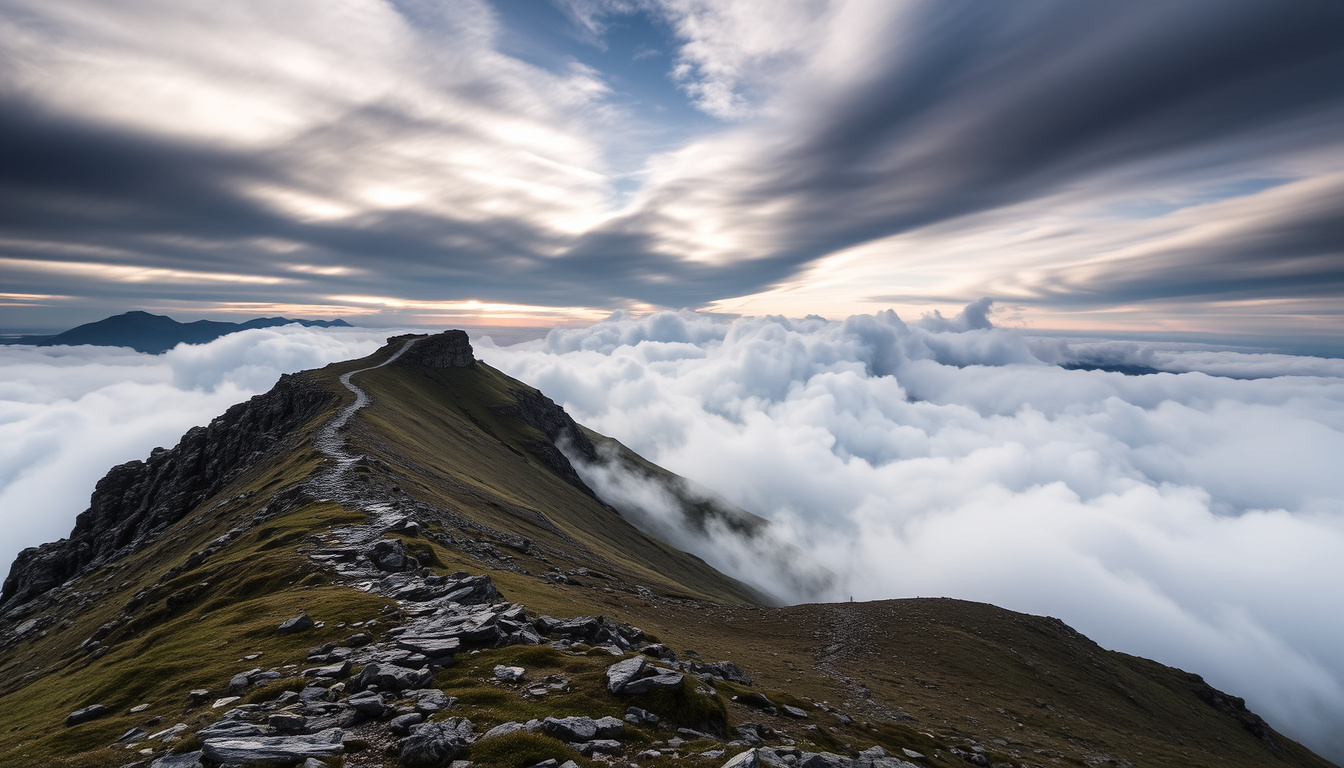
England’s highest mountain, Scafell Pike, rises to 978 metres (3,209 feet) in the heart of the Lake District National Park. Every year, thousands of walkers make the journey to its summit, drawn by the challenge and the sweeping views of Cumbria. The mountain is also a central pillar of the National Three Peaks Challenge, standing alongside Ben Nevis and Snowdon.
Despite its moderate height on a global scale, Scafell Pike is a serious mountain walk. Its terrain is rough and rocky, and the weather can shift from calm to hazardous in minutes. The summit plateau is exposed, making navigation difficult in mist or cloud. For anyone planning a climb, understanding the height, routes, weather, and history is essential to a safe visit, a fact echoed in any thorough guide to Scafell Pike.
How high is Scafell Pike and how does it compare to other peaks?
Scafell Pike stands at 978 m (3,209 ft) above sea level, making it the highest point in England. Its parent peak, by topographic prominence, is Snowdon in Wales. While it is a giant of the English landscape, it is only the third highest mountain in the United Kingdom, behind Ben Nevis (1,345 m) and Snowdon (1,085 m).
Height: 978 m (3,209 ft)
Location: Lake District, Cumbria
National Park: Lake District National Park
War Memorial: Designated in 1919
In the context of the National Three Peaks Challenge, Scafell Pike is usually the second summit attempted. Although it is the shortest of the three, many participants find it the steepest and most technical. As noted by a Three Peaks Challenge guide, its rough terrain and navigation challenges can make it a pivotal point in the challenge’s success.
- England’s highest mountain, but third in the UK after Ben Nevis and Snowdon.
- A central component of the National Three Peaks Challenge.
- The easiest route is from Wasdale Head, but it still requires solid preparation.
- Weather on the summit is notoriously changeable, even in summer.
- Its prominence of 912 m classifies it as a marilyn.
- The mountain is composed of Ordovician volcanic rock over 450 million years old.
- Broad Crag Tarn, on its slopes, is the highest standing water in England.
| Scafell Pike at a Glance | |
|---|---|
| Height | 978 m (3,209 ft) |
| Prominence | 912 m (2,992 ft) |
| Parent Peak | Snowdon |
| Location | Southern Fells, Lake District, Cumbria |
| OS Grid Reference | NY 21507 07212 |
| Geology | Ordovician volcanic rock |
| War Memorial | Gifted to the National Trust in 1919 |
| Highest Water Body | Broad Crag Tarn |
More context on the height and history is available on Wikipedia’s entry for Scafell Pike.
What are the best routes up Scafell Pike?
The Wasdale Head Route
The shortest and most popular route begins at Wasdale Head. The path follows Lingmell Gill, climbs through Brown Tongue, and crosses Hollow Stones to Lingmell Col before the final rocky ascent to the summit. It is steep and rough, covering roughly 6–7 miles round trip, and typically takes 5–7 hours.
The Corridor Route
Starting from Seathwaite, the Corridor Route is longer at 9–10 miles and offers a more scenic approach. It requires solid experience due to complex terrain and exposed sections. This route is often favoured by those seeking a less direct ascent.
Other Approaches
Eskdale provides a quieter, remote route, while Borrowdale and Great Langdale approaches are best suited for full-day or multi-day traverses of the Lake District fells. Detailed route information is available from the National Trust climbing page.
The paths on Scafell Pike are rocky, indistinct, and frequently intersect. A paper map and compass are essential, not optional. A GPS device or phone app is a helpful backup, but service can be unreliable in the high fells. Knowing how to navigate in poor visibility is a core skill for this mountain.
What is the weather like on Scafell Pike?
A Climate of Extremes
Conditions on the summit are frequently far worse than those in the valley at Wasdale. Wind speeds increase significantly with altitude, and cloud can reduce visibility to a few metres. Rain, sleet, and snow can fall in any season, making the mountain a genuinely hazardous environment for the unprepared.
Checking a mountain-specific forecast is crucial. The general Lake District forecast is not sufficient. The Met Office mountain forecast provides detailed predictions for the high ground. For those taking on the National Three Peaks, dedicated Three Peaks Challenge advice recommends checking conditions for each mountain separately.
Preparation is Safety
Winter conditions require specialist equipment including crampons and an ice axe, along with the training to use them. Even in summer, a headtorch, spare layers, and sufficient food and water are mandatory. The descent is often slower and more dangerous than the ascent, as fatigue sets in on the loose, uneven ground.
A clear forecast at Wasdale Head does not guarantee clear conditions on the summit. Microclimates on the fell can produce sudden squalls, hail, or a complete whiteout. If the forecast looks unstable, turn around early. The mountain will be there another day.
What accommodation is available near Scafell Pike?
The closest accommodation to the Wasdale route is the Wasdale Head Inn, a historic climbers’ hotel that sits right at the trailhead. There are also seasonal campsites and bunkhouses in the valley, ideal for an early start but with limited facilities.
For more choices, Keswick and Borrowdale offer a wide range of hotels, B&Bs, and shops. Ambleside and Windermere have the most services but require a longer drive to the mountain. Cockermouth is a practical base for western approaches. The official Lake District National Park Authority provides visitor information for the area.
For a standard walking holiday, it is safer and more enjoyable to stay locally and dedicate a single day to Scafell Pike. Combining it with a major summit from a different base or long drive on the same day can compromise safety and the overall experience.
What is the history of Scafell Pike?
Scafell Pike’s history is a blend of geography, literature, and national remembrance. While its ancient past is etched in volcanic rock, its modern significance was shaped in the 20th century.
- Pre-19th century: The mountain was known to local shepherds and hunters, but no specific first ascent was ever recorded.
- 1819: The poet Samuel Taylor Coleridge provides the first known written description of the mountain.
- 1919: Lord Leconfield gifts the mountain to the National Trust as a war memorial for those who died in World War I.
- 1951: The Lake District is designated a National Park, ensuring the landscape’s protection.
- 2007: A stone shelter is built on the summit plateau as a permanent memorial to the fallen.
What is known for certain about Scafell Pike?
| Established Information | Remaining Questions |
|---|---|
| Height: 978 m (3,209 ft) confirmed by Ordnance Survey. | The exact etymology of the name “Scafell” is uncertain, likely from Old Norse “skalli” (bald) and “fjall” (mountain). |
| Pronunciation: /ˈskɔːfɛl/ (skaw-fell) is the accepted standard. | The details of the very first ascent are not documented in historical records. |
| Simplest route: The path from Wasdale Head is the most straightforward and popular. | Precise details of ancient bronze age activity on the fell remain incomplete. |
Why is Scafell Pike significant?
Scafell Pike’s significance is multifaceted. Geologically, it is part of the Borrowdale Volcanic Group, formed in a massive eruption roughly 450 million years ago. Its rugged character is a direct result of this ancient volcanic past and subsequent glaciation.
Culturally, the mountain has captured the imagination of artists and writers. The dramatic landscapes of the Lake District were a powerful draw for the Romantic movement. The English tradition of landscape painting was profoundly shaped by figures like JMW Turner – The Painter of Light, His Life and Art, who conveyed the raw power of nature in his work, reflecting the character of places like Scafell.
Today, the National Trust manages the mountain, balancing public access with the need to combat erosion on the heavily used paths. Responsible walking and adhering to the Countryside Code help preserve this iconic English summit for future generations.
What do official sources say about Scafell Pike?
“Standing at 978 metres tall, Scafell Pike is England’s highest mountain and war memorial.”
— National Trust
“Scafell Pike is a mountain in the Lake District region of Cumbria, England. It has an elevation of 978 metres (3,209 ft) above sea level.”
— Wikipedia
“Scafell Pike…is 978 metres high, the smallest of the National Three Peaks of Great Britain.”
— Three Peaks Challenge UK
The story of perseverance against great odds is not limited to mountains. The reign of a young king, as detailed in Edward VI Biography Cause of Death Successor and Height, offers a different perspective on challenges and legacy in English history.
Key takeaway for climbing Scafell Pike
Reaching the summit of Scafell Pike is a memorable achievement, but it demands respect. The key to a safe and rewarding experience lies in preparation: checking a mountain-specific weather forecast, choosing the right route for your ability, carrying a map and compass, and equipping yourself for sudden weather changes. Whether you are completing the Three Peaks Challenge or simply exploring the Lake District, a planned approach will make all the difference.
Is Scafell Pike harder than Snowdon?
Many walkers find Scafell Pike more challenging due to its rougher terrain and less defined paths, though Snowdon is significantly taller. The difficulty depends largely on the route chosen and weather conditions.
Can you climb Scafell Pike in winter?
Yes, but only with proper equipment such as crampons and an ice axe, along with training in winter mountaineering. Routes become dangerous in snow and ice without this preparation.
How long does it take to climb Scafell Pike?
The classic round trip from Wasdale Head takes 4 to 5 hours. The ascent typically takes 2 to 3 hours, with the descent requiring 1.5 to 2 hours. Longer routes demand a full day.
What is Scafell Pike Lake?
This is another name for Broad Crag Tarn, the highest standing water in England. It is a small body of water located on the mountain’s rocky slopes.
Why is Scafell Pike a war memorial?
The mountain was gifted to the National Trust in 1919 by Lord Leconfield as a permanent memorial to the soldiers who died in World War I. A stone shelter on the summit commemorates this status.

Rebecca Haines is Managing Editor at DailyCity.co.uk, running the daily news list and covering UK and world stories with a city lens.